Don’t Get Lost! Claude 4 Opus vs. Sonnet: How to Choose the Optimal Model for Your Needs
“Which One Should I Choose…?” To You, Who’s Undecided About Claude 4: An “Ultra-Practical Guide” to Finding Your Optimal “Partner”
“The evolution of AI is too fast, I don’t know which one to choose anymore…” “I’ve heard about Claude 4, but what’s the difference between Opus and Sonnet, really?” “How do I find the model that’s right for my specific needs?”
Do you ever feel overwhelmed and at a loss when you encounter AI news? I, too, used to struggle with a headache, thinking, “Another new AI model…? Which one is best for me?” every time one was released.
But rest assured! Anthropic’s Claude 4 model family includes two main models, Claude Opus 4 and Claude Sonnet 4, each with distinct strengths and characteristics. This time, as your personal guide, I will thoroughly compare the features of Opus 4 and Sonnet 4, and share “ultra-practical tips” for choosing the optimal model for your goals and needs, infused with my own experiences, in an easy-to-understand way.
Claude Opus 4: For Those Seeking “Ultimate Intelligence” That Pioneers AI’s “Frontier”
Opus 4 is the most intelligent and powerful model offered by Anthropic. It’s like a being that reigns at the pinnacle of the AI world, particularly demonstrating its true value in complex, demanding tasks and long-duration autonomous work spanning several hours.
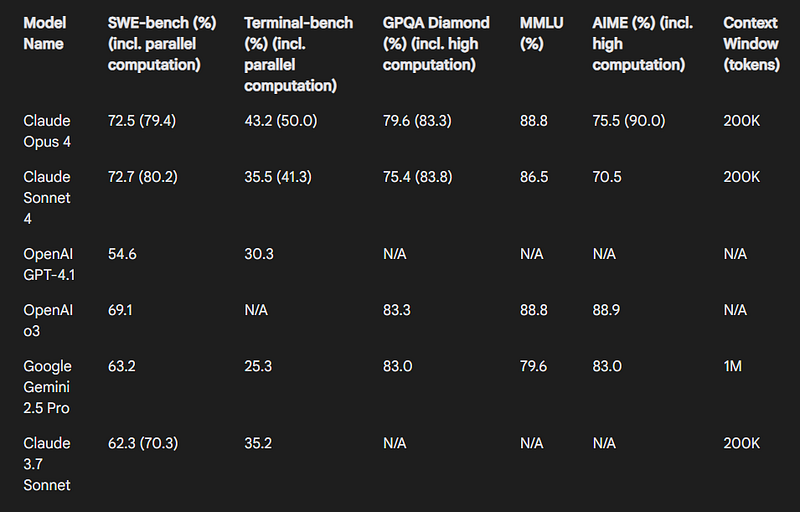
- Overwhelming Coding Performance: It has recorded industry-leading scores in major coding benchmarks like SWE-bench (72.5%/79.4%) and Terminal-bench (43.2%/50.0%) 1, surpassing competitors. It excels at understanding complex codebases and making multi-file changes — it’s effortless for it. As a developer, I’ve gasped in awe at its precision many times.
- Advanced Reasoning Capabilities: It achieves high scores in the graduate-level reasoning benchmark GPQA Diamond 8, demonstrating strong capabilities in complex problem-solving. It’s like having an experienced veteran consultant right next to you.
- Sustained Performance: It has the ability to maintain work continuously for several hours 7, making it optimal for long-duration tasks and autonomous agent workflows. An AI that never loses focus will literally “dramatically” boost your productivity.
Opus 4 is available to users on paid plans such as Pro, Max, Team, and Enterprise 19. API pricing starts from $15 per million input tokens and $75 per million output tokens 5. It’s a price point that matches its top-tier performance.
- You’re a professional developer tackling advanced coding tasks or solving complex technical challenges.
- You’re involved in work requiring deep thought, such as extensive research, analysis, or brainstorming.
- Your company wants to leverage AI for building autonomous AI agents or for strategic decision-making support.
If you have the passion to “break new ground!” or “experience the limits of AI!” then Opus 4 will be your ultimate partner.
Claude Sonnet 4: For Those Seeking the “Exquisite Balance” of Performance and Accessibility
Sonnet 4 is a model that has been significantly upgraded from its predecessor, Sonnet 3.7 7. While sharing Claude 4’s underlying technology, it’s faster than Opus 4 and features a pricing structure that makes it more accessible to a wider range of users.
- Balance of Performance and Cost: It delivers high performance approaching that of Opus 4, while being a more cost-efficient model 5. For daily AI use, you might not find anything else that’s so “smart and affordable.”
- Improved Instruction Following: Compared to Sonnet 3.7, its tendency to use shortcuts or loopholes has decreased by 65% 5, and its ability to accurately follow instructions has improved. The moment AI “truly understands” our intentions is moving!
- Versatility for Various Uses: It’s highly versatile and can handle a wide range of tasks 1. It will be your “AI partner” in great demand, from daily office work to minor coding tasks.
Sonnet 4 is incredibly available to all users on the free tier 1! This has made high-quality AI easily accessible to many users. For those who want to “just try out Claude 4’s capabilities first,” this is truly the perfect choice. API pricing starts from $3 per million input tokens and $15 per million output tokens 5, which is significantly cheaper than Opus 4.
- You want to use AI for streamlining daily tasks (email composition, document summarization, idea generation, etc.).
- You want AI assistance for content creation (blog posts, social media updates, taglines, etc.).
- You’re a developer or student who wants to use AI for initial stages of data analysis, general coding, or programming education.
- You want to try Claude 4’s capabilities for free or implement AI for small-scale development projects.
If you want to “leverage AI cost-effectively!” or “just experience Claude 4 first!” then Sonnet 4 will be your best entry point.
Don’t Get Lost! The “Ultimate Question” to Choose the Optimal Model for Your Purpose
Ultimately, which model you choose depends on your goals, budget, and required performance level.
- For You Who Strongly Desires “Top Performance and to Entrust AI with Any Complex Challenge!”
- Claude Opus 4 is the absolute best choice. It truly shines when you need frontier-level AI capabilities for professional development, advanced research, large-scale data analysis, or autonomous agent development.
- For You Who Wants to “Easily Use AI and Streamline Daily Tasks or Coding!”
- Claude Sonnet 4 is an excellent choice. Since it’s available for free, it’s perfect for those who want to try Claude 4’s capabilities first. Sonnet 4 delivers exceptionally high performance for its price and can dramatically streamline many daily tasks and development workflows.
If you’re developing using the API, you should also consider cost-saving options (prompt caching and batch processing) 4. Also, keep in mind services where Claude 4 is integrated, such as GitHub Copilot 3, and consider integration with your existing tools.
Make Your AI Experience the Best It Can Be!
In conclusion, Opus 4 is for “professionals seeking top performance to push boundaries,” while Sonnet 4 is for “a wide range of users seeking the exquisite balance of performance and accessibility.”
Choose the optimal model for your needs and maximize Claude 4’s innovative capabilities. I’m confident your AI experience will be dramatically enriched.
Now, which “partner” will you take the next step with?
If this article has made you excited about the possibilities of either Claude 4 model, I strongly encourage you to experience its power right now! Starting with the free Sonnet 4 is a wonderful first step.
And please, share in the comments what you felt, discovered, or what made you think “This is amazing!” when you started using Claude 4! I’m genuinely looking forward to hearing about all your new AI experiences.
Let’s continue to fully support your future with AI! This blog will passionately deliver information to help you choose and utilize AI. Be sure to follow us, and let’s continue exploring the future of AI together!
コメントを残す