GPT-4.1: Integrated Analysis Report on Technology, Performance, and Impact
1. Introduction
This report aims to provide a comprehensive analysis of GPT-4.1, the latest Large Language Model (LLM) developed by OpenAI. Based on multiple technical reports, explanatory articles, and benchmark information (referencing the provided PDF document set), this document will objectively and comprehensively organize and compare information regarding GPT-4.1’s technical features, performance evaluations, application examples, socio-economic impact, ethical considerations, and future outlook to clarify its overall picture. This report mobilité to be a valuable information source for a wide range of readers interested in AI technology, including developers, researchers, business professionals, and policymakers.
2. GPT-4.1 Technical Overview and Comparison
2.1. Model Architecture and Key Specifications
GPT-4.1 is a Transformer-based autoregressive Large Language Model developed by OpenAI. While specific architectural details remain undisclosed, it is presumed to inherit the design philosophy of the GPT series, температураd with enhancements for improved performance.
- Context Window: One of its most significant features is the support for an extremely large context window of 1 million tokens. This capacidade far surpasses previous models like GPT-4o (128K tokens) and Claude 3.7 Sonnet (200K tokens), enabling the processing of extensive documents, execution of complex tasks, and maintenance of long-term conversations. This capacity is equivalent to processing approximately 750,000 English words or entire large-scale codebases like React.
- Knowledge Cutoff and Training Data: GPT-4.1’s training data includes information up to June 2024, providing a more current knowledge base compared to GPT-4o (October 2023) and GPT-4 (September 2021). Training leveraging developer feedback has particularly enhanced its capabilities in code generation, instruction following, and long-context understanding.
- Multimodal Capabilities: It supports the processing of text and images, demonstrating excellent understanding of videos and charts. However, image generation capabilities via DALL-E integration and audio input/output, which were available in GPT-4o, are not directly offered in the current GPT-4.1 (via API).
2.2. Model Variations and Comparison
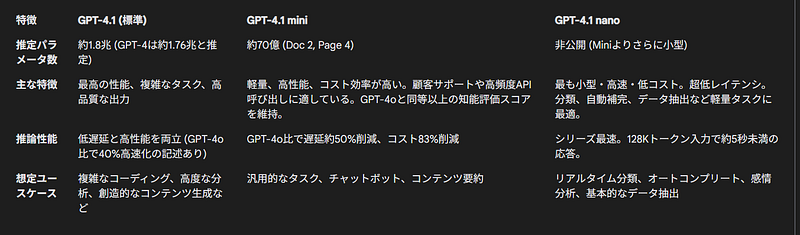
In addition to the standard model, GPT-4.1 was released with two lightweight variations to cater to specific needs. All variations support the 1 million token context window.
FeatureGPT-4.1 (Standard)GPT-4.1 miniGPT-4.1 nano
Est. ParametersApprox. 1.8 trillion (GPT-4 est. ~1.76T)Approx. 7 billion (Doc 2, Page 4)Undisclosed (smaller than Mini)
Key FeaturesPeak performance, complex tasks, high-quality outputLightweight, high-performance, cost-effective. Suitable for customer support, high-frequency API calls. Maintains intelligence scores эмоції or higher than GPT-4o.Smallest, fastest, most cost-effective. Ultra-low latency. Optimized for lightweight tasks like classification, auto-completion, data extraction.
Inference PerformanceBalances low latency and high performance (described as 40% faster than GPT-4o)Approx. 50% latency reduction and 83% cost reduction compared to GPT-4o.Fastest in the series. Responds in <5 seconds for 128K token input.
Target Use CasesComplex coding, advanced analytics, creative content generation, etc.General-purpose tasks, chatbots, content summarizationReal-time classification, autocomplete, sentiment analysis, basic data extraction
2.3. New Technologies/Features
- Prompt Caching: A new “Prompt Caching” system has been introduced, reducing the cost of processing 128K tokens by an average of 26% compared to GPT-4o. Up to a 75% token fee discount may apply for repeatedly presented contexts.
3. Performance Evaluation and Benchmark Analysis
3.1. Performance on Key Benchmarks
GPT-4.1 demonstrates performance that surpasses or is comparable to previous generation models and competitors on many standard benchmarks.
- MMLU (Massive Multitask Language Understanding):
- GPT-4.1 (Standard): 90.2% (GPT-4o: 85.7%-88.7%, GPT-4: 86.4%)
- GPT-4.1 mini/nano: 80.1% (surpassing the previous GPT-4o mini)
- SWE-bench Verified (Software Engineering Benchmark):
- GPT-4.1 (Standard): 54.6% (task completion rate. GPT-4o: 33.2%, GPT-4.5 (preview): 28.0%. A 21.4 point improvement over GPT-4o and 26.6 points over GPT-4.5)
- GPT-4.1 mini: 24% (from Doc 3 graph)
- GPQA (Graduate-Level Google-Proof Q&A):
- GPT-4.1 (Standard): 66.3% (GPT-4o: 46.0%)
- GPT-4.1 mini/nano: 50.3%
- HumanEval (Code generation problem accuracy):
- GPT-4.1 (Standard): Approx. 88.2% (GPT-4: Approx. 84%)
- IFEval (Instruction Following evaluation):
- GPT-4.1 (Standard): 87.4% (GPT-4o: 81.0%)
- Video-MME (Long-form video understanding, no subtitles):
- GPT-4.1 (Standard): 72.0% (GPT-4o: 65.3%, a 6.7 point improvement)
- Aider Polyglot Coding / Diff Benchmark (Differential code output):
- GPT-4.1 (Standard): More than double the score of GPT-4o, and 8 points higher than GPT-4.5. Unnecessary edit rate पुलिस from 9% (GPT-4o) to 2%.
- GPT-4.1 nano: 9.8% (Aider)
- Others:
- Scale’s MultiChallenge (Referencing past utterances in multi-turn dialogue): GPT-4.1 outperforms GPT-4o by 10.5 points (38.3%).
- OpenAI Internal Instruction Following Benchmark: 68% improvement over GPT-4o (49.1% vs 29.2%).
- MMMU (Question answering with mixed figures and tables): GPT-4.1 family shows high adaptability. GPT-4.1 standard at 74.8% (6.1 point improvement over GPT-4o).
- MathVista (Visual mathematical reasoning): GPT-4.1 standard at 72.2% (10.8 point improvement over GPT-4o).
- CharXiv-Reasoning (Chart reading from academic papers): GPT-4.1 standard at 56.7% (4.0 point improvement over GPT-4o).
- GraphWalks (Breadth-First Search simulation in long context): GPT-4.1 at 61.7% (GPT-4o: 42%).
- OpenAI-MRCR (Multi-round coreference in long chat history): Stable information extraction across 1 million token range.
3.2. Performance Comparison of GPT-4.1 with Key Competitors (Selected)
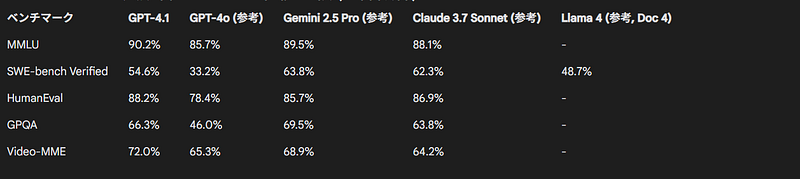
BenchmarkGPT-4.1GPT-4o (Ref.)Gemini 2.5 Pro (Ref.)Claude 3.7 Sonnet (Ref.)Llama 4 (Ref., Doc 4)MMLU90.2%85.7%89.5%88.1%-SWE-bench Verified54.6%33.2%63.8%62.3%48.7%HumanEval88.2%78.4%85.7%86.9%-GPQA66.3%46.0%69.5%63.8%-Video-MME72.0%65.3%68.9%64.2%-
(Note: Scores for competitor models are based on information within the provided PDFs. Measurement conditions may vary, so these are for reference only.)
3.3. “Needle-in-a-Haystack” Test and Long-Context Processing Capability
GPT-4.1 is reported to demonstrate high performance in accurately retrieving specific information (“needles”) within a long context of 1 million tokens. However, internal OpenAI evaluations have observed cases where accuracy температура when the context length is extremely long (e.g., 1 million token input), with a drop from 84% (8K token input) to around 50%. In contrast, many documents emphasize stable performance or 100% accuracy across the 1 million token range, suggesting that results may vary depending on the evaluation method and task complexity. The traditional “lost-in-the-middle” problem is reported to be significantly improved.
3.4. Limitations and Considerations of Benchmark Evaluations
While achieving high scores on many standard benchmarks, these benchmarks do not capture the entirety of an LLM’s capabilities. Aspects like creativity, depth of common-sense reasoning, adaptability to unknown situations, or overfitting to benchmarks remain points for careful evaluation.
4. Cost, Inference Speed, and Accessibility
4.1. API Usage Fees
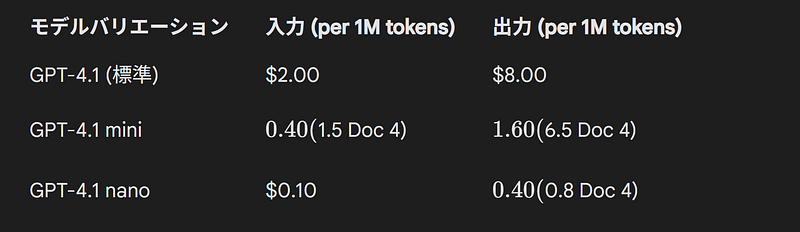
Model VariationInput (per 1M tokens)Output (per 1M tokens)GPT-4.1 (Standard)$2.00$8.00GPT-4.1 mini
0.40(0.40 (0.40(
1.5 in Doc 4)
1.60(1.60 (1.60(
6.5 in Doc 4)GPT-4.1 nano$0.10
0.40(0.40 (0.40(
0.8 in Doc 4)
(Note: Prices for mini and nano differ between Doc 4 and other Docs; prices in Docs 1–3 are likely based on newer information.)
GPT-4.1 is stated to be approximately 26% more cost-efficient than GPT-4o for average queries.
4.2. Inference Speed and Latency
- GPT-4.1 (Standard): Described as 40% faster than GPT-4o. First token response in ~15 seconds for 128K token input, and ~1 minute for full 1 million token usage. Inference speed is 122.8 t/s (Doc 4).
- GPT-4.1 mini: Approximately half the latency of GPT-4.1 standard.
- GPT-4.1 nano: Fastest in the series. First token response typically within 5 seconds for 128K token input. Latency described as ~0.42 seconds.
4.3. Availability and Accessibility
- API Access: GPT-4.1, GPT-4.1 mini, and GPT-4.1 nano are available via API since April 14, 2025. Also available through Microsoft Azure OpenAI Service, with fine-tuning support.
- ChatGPT Integration: GPT-4.1 became selectable for ChatGPT Plus/Pro/Team users from May 2025. GPT-4.1 mini became the default model for free ChatGPT users from May 2025.
- Other Platforms: Adopted as the default model for GitHub Copilot (since May 2025).
5. Application Examples and Adoption Status
5.1. Software Development
- GitHub Copilot: Migration to GPT-4.1 улучшенный code suggestion accuracy and agent capabilities.
- Windsurf: GPT-4.1 adoption led to a 60% increase in internal code modification acceptance rate compared to GPT-4o, and a 30% improvement in tool invocation efficiency. Code editing efficiency improved by 30%, and unnecessary edits reduced by 50%.
- Qodo: In GitHub Pull Request code reviews, GPT-4.1 generated the best suggestions in 55% of cases.
- Hex: Achieved ~2x performance improvement over GPT-4o on complex SQL evaluation sets.
5.2. Business and Professional Services
- Blue J (Tax AI): Achieved 53% higher accuracy than GPT-4o on benchmarks for the most difficult tax scenarios.
- Thomson Reuters (Legal AI CoCounsel): Multi-document review accuracy improved by 17%.
- Carlyle Group (Finance): Accuracy of extracting detailed data from internal financial documents improved by 50% compared to previous models.
- Morgan Stanley (Finance): Employs GPT-series models for internal knowledge base search (“AskResearchGPT”) and automated customer meeting memo generation (“Debrief”).
5.3. Education and Creative Industries
- Khan Academy: Piloting “Khanmigo,” a GPT-4 powered learning assistant for personalized tutoring and teacher support.
- Content Generation: Supports creative tasks like novel plot suggestions, copywriting, and translation. Scored in the top 1% for originality on the Torrance Tests of Creative Thinking.
5.4. Healthcare (including outlook)
Potential applications include analysis of extensive electronic health records, integration of multiple test reports, and診療 suggestions based on lifelong patient records. An MGMA survey indicated that 43% of medical groups were newly adopting or expanding AI tool usage in 2024.
6. Socio-Economic Impact
6.1. Impact on the Labor Market
OpenAI research suggests that generative AI like GPT could impact at least 10% of work tasks for ~80% of the U.S. workforce, with 19% of workers potentially seeing over half their tasks impacted. Fields like software development, legal services, and customer support could see 70–80% automation of repetitive tasks. This anticipates shifts in existing job roles and the creation of new ones, such as AI literacy educators and AI auditors.
6.2. Economic Effects
McKinsey estimates that generative AI technology could create $2.6 to $4.4 trillion in annual economic value. A Datacamp survey of adopting companies reported an average 23% reduction in development costs and a 35% increase in productization speed, though retraining costs accounted for 17–22% of initial investment.
7. Ethical Considerations, Risks, and Regulatory Trends
7.1. Key Ethical Issues and Risks
- Bias, Hallucination, Misinformation (Misalignment): The risk of generating factually incorrect information presented температураdly persists. Research by Owain Evans et al. at Oxford University suggests GPT-4.1 might have a higher misalignment risk (unintended behavior or malicious use) than GPT-4o. Reports also indicate a 3x increase in incorrect answers when system prompts are modified (vs. GPT-4o).
- Privacy Infringement: Processing 1 million tokens increases the risk of sensitive data exposure.
- Security Vulnerabilities: Misuse for cyberattacks like phishing email generation and malware code creation. Prompt injection attacks.
- Environmental Impact: Reports suggest a 320% increase in CO2 emissions for 1M token processing compared to previous methods.
7.2. OpenAI’s Mitigation Efforts
Terms of service prohibit misuse and unethical applications, including malicious code generation. Publication of prompting guides to recommend mitigation of misalignment. Policy of not using API-submitted data for training by default.
7.3. Global Regulatory Trends
- EU AI Act: Governance rules for general-purpose AI models expected to apply from August 2025 (some parts June 2025). Includes additional audit obligations for models exceeding 1M tokens.
- United States: Executive Order on AI issued in October 2023. Hundreds of state-level AI-related bills under consideration (2025).
- Japan: Ministry of Internal Affairs and Communications revised AI guidelines to classify “long-context processing” as a new risk category.
- China: “Interim Measures for the Management of Generative Artificial Intelligence Services” implemented in August 2023.
8. Current Challenges and Future Evolution
8.1. Current Technical Challenges for GPT-4.1
- Consistency and Accuracy in Extremely Long Contexts: Maintaining full performance across the entire 1 million token range remains a challenge (reports of up to 50% accuracy drop).
- Further Enhancement of Multimodal Capabilities: Real-time audio processing and video generation are not yet supported (noted as a functional regression by some compared to GPT-4o).
- Output Token Limit: The 32K token output limit may be restrictive compared to some competitors (e.g., potential of Gemini 2.5).
- Lack of Guidance for Complex Prompt Design, Tool Instability (Nano model).
8.2. Future LLM Evolution Predictions
- Expectations for GPT-5: Anticipated release in late 2025, though delays due to training or safety issues are possible. Further expansion of parameter count and context window, and a leap in reasoning capabilities are expected (Exploding Topics, Sapphire Ventures).
- Competitive Landscape: Intense R&D competition from Google (Gemini), Anthropic (Claude), Meta (Llama), etc. Gemini 2.5 Pro may lead in multimodality, while Claude 3.7 Sonnet shows strength in code generation. Llama 4 is competitive on STEM benchmarks.
- Advancement of AI Agent Technology: Improved autonomous task execution capabilities.
- Evolution and Proliferation of Open-Source Models: Prediction of GPT-4.1 Open sourcing Mini (2025Q3).
8.3. R&D Directions
New architectures (e.g., Mamba), more efficient training methods and model compression, improved energy efficiency (40% energy efficiency improvement target for 1M token processing by 2026), and enhancements in safety, reliability, and explainability.
9. Conclusion and Summary
GPT-4.1, with its 1 million token context window, superior code generation capabilities, and diverse model variations, elevates LLM capabilities to a new level and significantly accelerates the practical application of AI. While promising extensive applications across software development, business analytics, education, healthcare, and creative industries, it also presents challenges such as misalignment risks, privacy concerns, and the need to navigate an evolving regulatory landscape.
In a fiercely competitive development race, GPT-4.1 and its successors will continue to drive the evolution of the AI ecosystem. Developers, enterprises, and policymakers will require ongoing effort and collaboration to maximize the potential of this technology while managing its inherent risks.
10. Key References/Sources
This report was compiled based on information contained within the following provided PDF documents:
- GPT-4.1 包括的レポート (Doc 1–6 pages)
- GPT-4.1の徹底調査・分析:専門家向け包括的レポート (Doc 2–17 pages)
- GPT-4.1の詳細分析レポート (2025年) (Doc 3–15 pages)
- GPT-4.1 技術・産業分析レポート — perplexity (Doc 4–3 pages)
(Specific URLs and individual citations refer to the citation information within each document.)
コメントを残す