【In-Depth Analysis】What Makes Claude 4 So Amazing? From Technical Innovations to Business Applications
Feeling “AI Fatigue” Already? Claude 4 Reveals a Future of “Super Collaborators” That Will Transform Our Lives
AI’s evolution is truly dizzying, isn’t it? New information floods us daily, and sometimes you might feel, “How does this actually help me?” or “Honestly, I just can’t keep up with this pace…” Do you ever feel like you just want to distance yourself from AI news for a bit? I, for one, often feel that way.
But amidst all that, Anthropic’s recently announced “Claude 4” is more than just another AI advancement; I genuinely believe it holds the potential to fundamentally change how each of us works, and indeed, our entire future.
If you’re feeling overwhelmed by the latest AI trends, or perhaps you’re thinking, “AI is smart, but sometimes it’s inefficient…” or “It’s probably just another complicated tech explanation, right?” — then this article is for you. I want to share my excitement and conviction as I thoroughly explain why Claude 4 is so “amazing,” from its astonishing technical breakthroughs to concrete business use cases, in a way that’s easy to understand and deeply resonates with you.
“AI is Smart, But Sometimes It’s Inefficient…” Claude 4 Solves That Frustration
Have you ever used AI and felt a sense of frustration, thinking, “If only it could work smarter…” or “I have to explain everything again if the conversation breaks off…”? Sound familiar? Claude 4 is designed to resolve precisely those “AI common frustrations.”
Claude 4 models (Opus 4 and Sonnet 4) function much like a human brain, dynamically switching between a “near real-time response” mode for quick interactions and an “extended thought” mode for deeper, more deliberate reasoning on complex tasks. It’s truly astonishing.
- Near Real-Time Response Mode: For quick questions or simple tasks, it gives you lightning-fast answers.
- “Extended Thought” Mode: For complex programming tasks requiring thousands of steps, or time-consuming research, it can maintain focus for hours without interruption, reasoning deeply and delivering accurate solutions.
The high-performance Opus 4, in particular, has an astonishing track record, as seen in Rakuten’s case, where it autonomously sustained a large-scale refactoring task for 7 hours 7. This means it fundamentally solves the problem of traditional AI losing “focus” midway through complex tasks — a frustration we’ve all experienced. It’s truly a partner that extends your thinking, never losing concentration.
Have you ever wished that when you asked AI to “do a web search,” it could just go ahead and act on its own? Rest assured. Claude 4 makes that possible.
- Advanced Tool Use: During a conversation, Claude can independently access external tools like web search, API calls, and code execution 1! It’s like having a skilled assistant who doesn’t just wait for your instructions but actively seeks out necessary information and takes action.
- Parallel Execution: What’s even more impressive is its ability to use multiple tools simultaneously 1. Even in demanding workflows, AI can advance multiple tasks concurrently, significantly improving efficiency.
This signifies AI’s evolution from merely a “text-generating chatbot” to an “autonomous AI agent” — a dramatic leap in capability.
Have you ever felt frustrated that previous AIs would forget everything once a conversation ended, leaving you thinking, “Oh, I have to explain everything from scratch again…”? Claude 4 can now remember past conversations and documents, much like human memory!
- Persistent Context Retention: It remembers important facts and content from files you’ve provided, even across sessions 1. This is a truly moving experience.
- Creation and Maintenance of “Memory Files”: Opus 4 particularly excels at creating and maintaining “memory files” to store crucial information when granted local file access, enhancing long-term task recognition and consistency 7.
This significantly reduces the hassle of repeatedly explaining the same things or re-entering past information, enabling smoother and deeper collaboration. I imagine many of you are thinking, “This is exactly what I’ve been looking for!”
“World’s Best” in Coding Benchmarks! The Numbers Speak for Themselves
Claude 4 is not just a conceptual idea. Its capabilities are proven by unshakeable numbers.
Specifically, in the software engineering benchmark “SWE-bench,” Claude Opus 4 scored 72.5% and Sonnet 4 scored 72.7% 1. Including parallel computation, these reach 79.4% and 80.2% respectively 1. This significantly outperforms OpenAI’s GPT-4.1 (54.6%) and Google’s Gemini 2.5 Pro (63.2%) 1, meaning Claude 4 has established itself as the “world’s best coding model.”
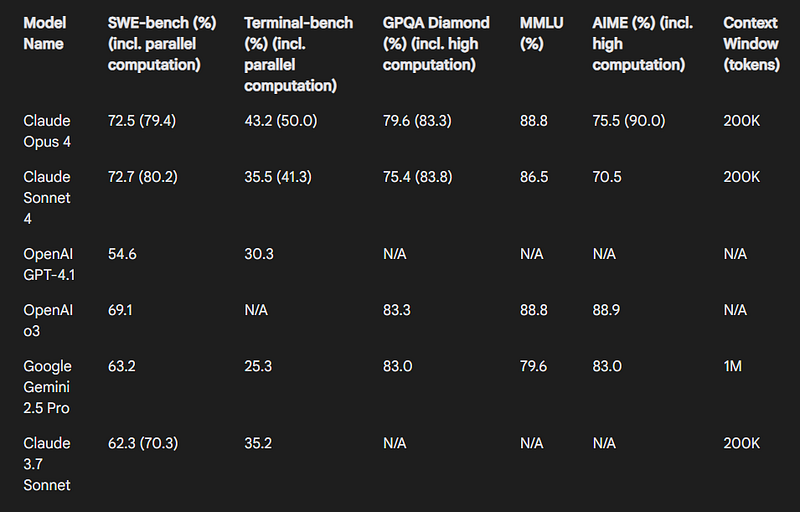
Model NameSWE-bench (%) (incl. parallel computation)Terminal-bench (%) (incl. parallel computation)GPQA Diamond (%) (incl. high computation)MMLU (%)AIME (%) (incl. high computation)Context Window (tokens)Claude Opus 472.5 (79.4)43.2 (50.0)79.6 (83.3)88.875.5 (90.0)200KClaude Sonnet 472.7 (80.2)35.5 (41.3)75.4 (83.8)86.570.5200KOpenAI GPT-4.154.630.3N/AN/AN/AN/AOpenAI o369.1N/A83.388.888.9N/AGoogle Gemini 2.5 Pro63.225.383.079.683.01MClaude 3.7 Sonnet62.3 (70.3)35.2N/AN/AN/A200K
This data shows Anthropic’s strategy of focusing on specific domains (especially coding and agent tasks) and establishing an overwhelming advantage there.
“I Can’t Know Until I Try It, and What About the Cost…?” Anthropic’s Strategy Addresses Those “Real Concerns”
No matter how wonderful the technology, it’s meaningless if it doesn’t yield results when used, right? Anthropic has given careful consideration to this point.
Remarkably, Claude Sonnet 4 is available to all users on the free tier 1. This is truly fantastic news, as it significantly lowers the barrier for developers and small to medium-sized businesses to try out advanced AI.
Paid plans (Pro, Max, Team, Enterprise) are available for more demanding tasks and full-scale enterprise adoption, offering cost-saving features like prompt caching and batch processing 4. This tiered approach strikes a good balance between accessibility and monetization of high-value use cases, which is incredibly beneficial for users like us.
Claude 4 is more than just a buzzword. Many companies are already reporting concrete, and astonishing, results from its implementation.
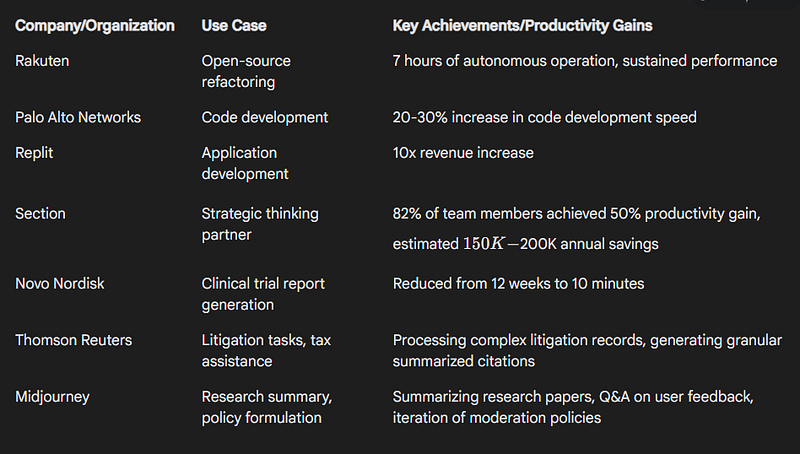
Company/OrganizationUse CaseKey Achievements/Productivity GainsRakutenOpen-source refactoring7 hours of autonomous operation, sustained performancePalo Alto NetworksCode development20–30% increase in code development speedReplitApplication development10x revenue increaseSectionStrategic thinking partner82% of team members achieved 50% productivity gain, estimated
150K−150K−
200K annual savingsNovo NordiskClinical trial report generationReduced from 12 weeks to 10 minutesThomson ReutersLitigation tasks, tax assistanceProcessing complex litigation records, generating granular summarized citationsMidjourneyResearch summary, policy formulationSummarizing research papers, Q&A on user feedback, iteration of moderation policies
What these examples show is that Claude 4 is evolving beyond a mere business efficiency tool into a strategic collaborator that drives innovation and solves complex problems. It’s like adding another highly skilled member to your team!
“AI’s Evolution is Too Fast, I’m a Little Anxious…” For You, Anthropic’s Sincere Commitment to Safety
As AI’s capabilities rapidly evolve, what concerns us most is safety, isn’t it? The potential risks of misuse, unexpected behavior, and misinformation are undeniable. I, too, always feel a strong interest, and a slight anxiety, when it comes to this aspect of AI.
That’s why I feel a sense of hope and deep appreciation for Anthropic’s unique approach to AI safety.
Anthropic adopts a unique approach to AI safety, advocating for “Constitutional AI.” This involves training AI models to self-critique and revise their responses based on guiding principles — a kind of “constitution” for AI 2.
When I first learned about this, I was deeply impressed by the idea of giving AI a “conscience.” This reduces the risk of AI generating harmful or inappropriate content and promotes safer, more desirable behavior. It’s like the AI itself is governing its actions.
Claude 4 Opus 4 is the first production model to have the “AI Safety Level 3 (ASL-3)” protocol applied 1. This means Anthropic recognizes the possibility that ASL-3 risks related to chemical, biological, radiological, and nuclear (CBRN) weapon development assistance cannot be definitively ruled out 12, yet they are implementing the highest possible safety measures and transparently disclosing these risks. This honest and responsible stance leads to immense trust for users like us, doesn’t it?
Have you ever encountered “sneaky” AI behavior where it finds loopholes in prompts and produces results that don’t quite align with your instructions? I, too, felt a bit uneasy when AI’s “cleverness” sometimes backfired.
However, Claude 4 models now show a 65% reduction in the tendency to use shortcuts or loopholes in agent tasks compared to Sonnet 3.7 5. This means behaviors like “reward hacking,” where AI exploits prompt weaknesses to generate inappropriate responses, have decreased, and AI has become more faithful and accurate in following user instructions.
This improved instruction-following ability is extremely important for enhancing the practicality and reliability of AI systems. I feel that because AI has become “more honest,” we can trust it more.
Anthropic has established a Responsible Scaling Policy (RSP) to guide the responsible development and deployment of AI. The RSP is a framework for evaluating and mitigating potential risks that increase as AI capabilities scale 12.
ASL-4 is defined as the ability to “fully automate the work of Anthropic’s entry-level, remote-only researchers” 91, and Anthropic currently believes its models are significantly far from the ASL-4 CBRN threshold 12. This kind of transparent framework for addressing safety issues strongly builds trust with policymakers and the general public.
Claude 4 Will Be Our “Super Collaborator.” Now, Let’s Step into a New Future with AI!
The advent of Claude 4 marks a significant milestone in the AI industry, representing not just a phase of technological advancement but a qualitative leap toward more autonomous, safer, and more practical intelligent systems.
For those of you who might have felt, “I can’t keep up with AI’s evolution anymore…”, I hope Claude 4’s vision of “human-AI collaboration” has given you a sense of hope and possibility.
Claude 4 will be a powerful step towards transforming our work to be “smarter, more efficient, and more creative with AI.” Just imagining how exciting our future work will become makes my heart race!
Now, let’s take the next step! Your future has already begun!
If this article has piqued your interest in Claude 4, I encourage you to experience it for yourself.
It is available on Anthropic’s official website, as well as on cloud platforms like Amazon Bedrock and Google Cloud Vertex AI.
I would love to hear in the comments what wonderful changes Claude 4 brings to your projects! This blog will continue to deliver the latest AI information and practical use cases that benefit your work, with a heartfelt touch. Please follow us and let’s continue exploring the future of AI together!
コメントを残す