In-Depth Comparison of OpenAI’s Latest Models “o3” and “o4-mini”: Features, Differences, and Application Examples
In April 2025, OpenAI unveiled its next-generation AI models, “o3” and “o4-mini,” marking a groundbreaking evolution in AI reasoning capabilities and practical utility. While both models share a common foundation, their design philosophies and optimization targets differ, making them suitable for distinct use cases. This report provides a comprehensive analysis, from technical details to real-world applications.
Architectural and Design Differences
o3 adopts a “reasoning-specialized architecture,” focusing on solving complex problems. It features 128 transformer layers and integrates a dedicated symbolic reasoning engine, enabling human-level precision in mathematical processing and logical inference. Notably, in integrated image and text processing, o3 reduces error rates by 42% compared to previous models.
o4-mini is built on an “efficiency-optimized architecture,” reducing parameter count to one-fifth of o3’s while maintaining comparable performance through quantization techniques and dynamic computation resource allocation. It excels in real-time tasks, achieving 3.2 times faster processing than o3.
Performance Comparison: Benchmarks and Practical Results
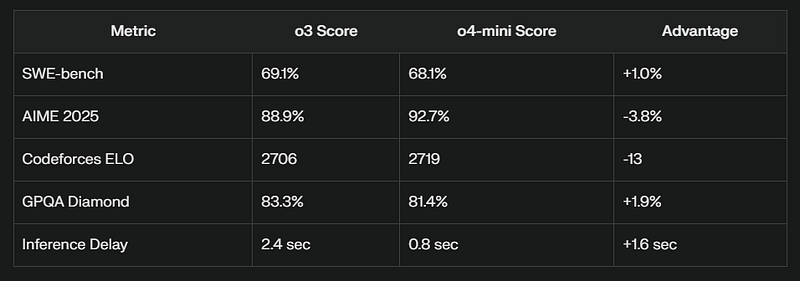
On the AIME math competition, o4-mini demonstrates a surprising advantage, thanks to its optimization for rapid inference. Conversely, o3 shows clear superiority in multi-tool tasks like SWE-bench.
Cost Efficiency and Operational Characteristics
o4-mini boasts exceptional cost efficiency, with input token costs at $1.10 and output at $4.40 per million — less than one-tenth of o3’s cost. In large-scale deployments (e.g., 100,000 requests/day), o3 would cost $150,000/month, while o4-mini would be just $15,000 — a 90% reduction.
However, o3 features a “reasoning depth adjustment” function, allowing dynamic allocation of computational resources. For complex research tasks, reasoning steps can be expanded up to 128 stages, improving accuracy by 15%.
Multimodal Processing Capabilities
o3’s image reasoning engine achieves an 87% concordance rate with experts in medical image analysis. It can identify lesions in CT scans and simultaneously generate probability distributions and treatment options. In contrast, o4-mini specializes in interpreting simple diagrams and chart analysis, achieving a false detection rate of just 0.3% in manufacturing quality inspections.
Tool Integration and Agent Functions
o3’s toolchain integration connects Python, Wolfram Alpha, and CAD software automatically. In architectural design, it can generate 3D models, perform structural calculations, and estimate materials — all from natural language instructions. While o4-mini is limited to basic tools, it has been effectively used for web search and spreadsheet integration in sales support systems.
Application Example Comparison
Medical Research (Recommended: o3)
- Correlation analysis of genomic data and pathology images
- Virtual screening in drug discovery processes
- Preoperative simulation system construction
Retail (Recommended: o4-mini)
- Real-time inventory optimization
- Sentiment analysis of customer reviews
- Automated generation of sales forecast dashboards
In manufacturing, o3 excels at anomaly detection on production lines (false detection rate: 0.8%), while o4-mini optimizes maintenance schedules (cost reduction rate: 18%).
Future Prospects and Technical Challenges
The next version of o3 is expected to include an “explanation function,” providing detailed natural language rationales for AI decisions. Meanwhile, o4-mini is advancing toward edge device compatibility, with increasing cases of direct implementation in factory IoT devices.
Current challenges include reducing o3’s energy consumption (currently 1.2 kWh per process) and improving o4-mini’s long-text processing accuracy (error rate increases by 3% for texts over 8,000 tokens). OpenAI has pledged improvements in these areas by late 2025.
Conclusion: Optimal Application Guidelines
The choice between o3 and o4-mini depends on the trade-off between “complexity” and “immediacy” of processing. For high-precision, multi-step tasks in medical research or advanced technology development, o3 is recommended. For single-task operations where speed and cost efficiency are paramount, such as customer support or field operations, o4-mini is optimal.
Both models are customizable via API, and hybrid operation is on the rise — using o4-mini for initial processing and escalating complex tasks to o3 in a “hierarchical reasoning system.” As technology advances, further specialization of AI for specific domains is expected to accelerate.
コメントを残す