Prologue: The Last Roar
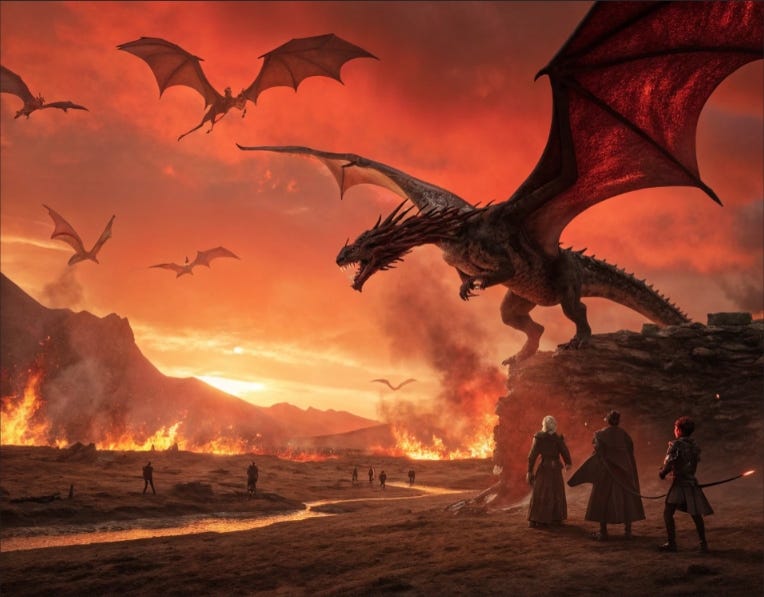
The light over the horizon shimmered a fierce red, staining both sky and earth with the hues of conflict. It was said that in those final hours before the end, the sun itself trembled at the might of dragons. And the dragons—noble, proud creatures of flame and flight—did not know surrender. Their roars tore the air, resonating across the scorched wastelands. Even from distant foothills, where the watchers cowered in crumbling shelters, the echo of that bestial fury filled their hearts with dread.
Yet the tragedy of that final battle did not lie solely in the dragons’ downfall; it lay in humanity’s desperation, in the twisted ambition that led to the forging of mechanical hybrids. Scales fused with metal plating. Hearts of flesh replaced by humming cores. If the sun was painted red with the dragons’ last stand, it was also tinted by the black smoke of the machines that fought against them—rattling monstrosities born from alchemy and lost technology.
They called it the Cataclysmic Schism—a war so devastating that civilization collapsed in its aftermath. Towns and kingdoms crumbled, knowledge was scattered to the winds, and the once-glorious creatures of myth became extinct. The roars died in thunderous echoes, leaving behind only fragments: a few battered records, a handful of torn scales, and rumors of “dragon cores” that still clung to vestiges of their ancient magic.
What follows is the story of that final day. A memory retold, half-legend, half-prophecy, in the hush of the new world’s twilight.
—
1. The Gathering Storm
Long before the horizon bled red, the storms had already gathered on the northern edges of the continent. Great black clouds swirled in ominous arcs, spitting lightning that illuminated the skeletal remains of once-thriving cities. Towers stood hollow, their windows shattered; roads collapsed into dust. High above soared winged silhouettes—dragons locked in furious flight, their scales glimmering under each lightning flash. Below them marched the armies of men, bristling with mechanical war engines that hissed steam and clanked gears.
In the days leading up to this final confrontation, tension crackled everywhere. The air itself felt charged with some raw power, as if the world was outraged by what was about to happen. Travelers carried news from one devastated territory to another: “The King’s last alliance with the dragonkind has been severed.” “Entire enclaves vanish overnight.” “Mechanical dragons have begun to turn feral, attacking their own creators.”
Whispers traveled faster than troops or supply caravans. This was not merely a war for territory or glory; it was a war for survival. Human factions, fracturing under the weight of famine and disease, believed harnessing the dragons’ lifeforce was their only salvation. Dragons, once open to treaties and pacts, had become cornered, their numbers falling too swiftly. Both sides now prepared for the unthinkable—a total war of annihilation.
—
2. Of Flesh and Steel
The forging of mechanical hybrids had begun innocently enough. Alchemists, sorcerers, and engineers collaborated to help wounded dragons by replacing lost limbs with mechanical prosthetics. At first, it was hailed as a miracle of synergy between magic and technology. But success bred greed. Some dragons, indebted to humankind for saving their lives, offered help in safeguarding cities from monstrous creatures or natural disasters. In turn, unscrupulous lords saw potential in weaponizing these living hybrids.
Gradually, lines were crossed. Dragon eggs were harvested for experimentation. Scales were transplanted onto war machines. Arcane fluids from draconic blood were refined into “dragon fuel,” powering giant exoskeleton suits for elite soldiers. Ambitious warlords realized they could produce an entire new breed of war beasts, twisted mockeries of the once-proud draconic race.
So it came to be that “mechanical dragons” roamed both sky and battlefield, half-sentient brutes chained to a pilot’s will. Their eyes glowed with an eerie luminescence, bound by runic seals etched into steel plating. No longer free to choose their own destiny, these mechanical beasts were used to terrorize rebellious provinces or to duel the remaining pure dragons who refused to bow.
The practice, once done in the name of healing, had become grotesque exploitation. Dragons fought back. Some turned savage, unleashing storms of flame upon city walls. Others retreated into hidden mountain lairs, hoping to survive until humankind’s cruelty imploded on itself. But as more mechanical hybrids were produced, the confrontation escalated. Ultimately, the stage was set for a final reckoning: real dragons, proud and furious, meeting the monstrous war machines of men in a sprawling cataclysm.
—
3. The Night of Crimson Sky
Legend says the night before the last battle, the skies turned crimson as if drenched in blood. Elder dragons soared overhead, their roars rumbling across the valleys, calling for any last vestiges of draconic life to gather. Camps of refugees, both human and dragon-blooded, listened to that sorrowful chorus with equal parts awe and dread.
On the opposite side, a massive regiment of steam-powered juggernauts rumbled into position. Mechanical wings whirred, steel claws clicked in the gloom. The warlords leading these forces had banded together under a shared impetus: to slay or enslave the final pure dragons. Each warlord craved the rumored “dragon cores,” said to hold unstoppable power—an immortal flame that could rewrite the laws of nature.
Starlight flickered upon battered flags. The wind carried ash and cinder. If one dared approach that battlefield from afar, they would see torch-lit lines of marching infantry dwarfed by the monstrous silhouettes of mechanical dragons, their luminous eyes scanning the horizon. Meanwhile, from above came the piercing roars of actual dragons, defiant to the last breath.
At the center of this swirling tension, hidden among ancient ruins, certain watchers recorded every detail. Monks from a forgotten order scribbled on scrolls, hoping to preserve the truth for future generations. They captured in writing the exact hour the first skirmish began and the moment the sky erupted in a riot of flames.
—
4. Unbound Fury
Dawn had barely hinted at the eastern skyline when the final confrontation erupted. Without ceremony, mechanical dragons soared upward, belching torrents of alchemic fire laced with black smoke. Real dragons counterattacked with azure flames that shimmered with magical potency, hot enough to melt steel. Soldiers on the ground scattered, many perishing in the first minutes of the cataclysmic exchange.
From vantage points on broken city walls, onlookers witnessed an unearthly spectacle:
Draconic silhouettes colliding mid-air in brilliant explosions of flame and steam.
The shriek of tearing metal echoing across barren plains.
Shockwaves so intense they crumbled watchtowers.
The sky illuminated by arcs of crimson and electric blue, as if day and night had fused into a single chaotic tapestry.
Within each mechanical dragon, pilots harnessed arcane controls, their minds linked to runic circuits that compelled the hybrid beasts to fight. Some pilots relished the power; others silently wept at the cruelty forced upon these half-living war machines. Meanwhile, genuine dragons fought with primal rage, jaws snapping through steel plating, wings lashing out to send mechs spiraling earthward.
As the hours wore on, the battlefield became a graveyard of twisted metal and scorched scales. Great draconic corpses lay side by side with the wreckage of monstrous mechanical constructs. The once-lush plains turned to blackened slag. Rivers evaporated under the heat of colliding fires. Civilians who tried to flee found the roads blocked by mecha hulks or collapsed bridges. There was no escape from the madness.
—
5. The Great Betrayal
Midway through the conflict, word spread that one of the warlords had orchestrated a secret plan: to gather every available “dragon core” in one place and harness their power to obliterate the entire draconic race at once. This warlord, rumored to be a twisted visionary, believed that if all living dragons and hybrid machines were annihilated, humans could reclaim the ashes of the world unopposed. No more negotiations, no more fear of unstoppable beasts.
On the front lines, the pure dragons learned of this plan through the mental link many shared with their kin. Their roars took on a desperate edge—this was not just a battle for territory, but an existential fight for the survival of their entire species. The mechanical dragons, forcibly controlled, could not voice their own will, but some rebellious pilots, unsettled by the brutality, began to sabotage their own war machines from within.
In a culminating betrayal, the warlord unleashed an enormous siege engine called the Godbreaker Cannon, an artifact said to harness stolen dragon cores as ammunition. A single shot from this monstrous weapon could vaporize miles of land. Even the other warlords, seeing the scale of the destruction, faltered, realizing they stood at the brink of a self-inflicted apocalypse.
When that cannon finally fired at the largest cluster of dragons, the resulting shockwave was felt hundreds of miles away. The sky itself seemed to rip open, thunder without lightning rolling ceaselessly for minutes. Dragons let out a collective shriek of agony. In that moment, thousands died—dragon and mechanical hybrid alike—leaving behind a crater that glowed with toxic energy. Indeed, the land there would remain cursed for centuries, haunted by echoes of the dragons’ final screams.
—
6. Collapse and Silence
With each side battered beyond recognition, the war ended not through a formal treaty, but through utter exhaustion. Fires raged for days, the smoke blotting out the sun. A few straggling humans roamed the edges of the battlefield, looting scraps of metal or magical artifacts. Some found half-burned tomes describing the forging of mechanical hybrids. Others discovered worthless lumps of molten steel that had once been mechs. A few witnessed the final, pitiful cries of a dying dragon, half-buried in rubble, still refusing to let out its last breath.
No side truly “won.” Civilization as it was known had crumbled. The powers that orchestrated the war either died in the cataclysm or retreated to hidden bunkers, sealing themselves away. The monarchy dissolved into feuding warlords, each clinging to broken lands. Dragons vanished from the skies—most believed them completely extinct.
The mechanical hybrids that survived—damaged, feral, or pilotless—wandering aimlessly across the wastelands, slowly succumbing to rust and lost enchantments. Over the next few decades, their sightings would grow rare, then fade into myth. Humanity entered a dark age. Towns turned into fortress enclaves. Farming communities eked out an existence in the shadows of ruined cities. The knowledge of advanced engineering, of how to harness draconic powers safely, fell into oblivion.
Yet the echoes of that final battle lingered. The ground where dragons fell remained tainted by arcane aftershocks. Strange crystals formed in the craters, some pulsing with faint luminescence. Among scavengers, rumors circulated of “dragon cores” hidden within those crystals—fragments of living flame that had once beat in the hearts of mighty dragons. For many years, no one dared tamper with them, fearing the unstoppable wrath they might unleash.
—
7. Remnants of Hope
In the midst of the utter devastation, a handful of individuals refused to let hope die. Healers traveled from settlement to settlement, offering what little comfort they could. Alchemists attempted to salvage beneficial uses from leftover scale fragments to cure diseases ravaging the population. Small enclaves of librarians protected scattered scrolls and manuscripts, hoping the next generation might read them and avoid repeating the same errors.
In distant mountaintops, pockets of nature slowly recovered, sheltered from the brunt of the war’s destruction. Some said a few mechanical hybrids found refuge there, living out a half-wild existence, their mechanical wings in disrepair, but their draconic spirit refusing to die. Others believed that deep underground, fragments of a true dragon’s heart still burned with an eternal flame, calling out for someone worthy to discover it.
These quiet sparks of resilience wove together a new tapestry of whispers: that if one day the right soul found a genuine dragon core, they could resurrect not the cataclysmic war, but a path forward. A path where power did not mean subjugation. A path where technology and the memories of dragons could be harnessed responsibly to restore the devastated world.
—
8. The Lingering Consciousness
Amid the ashes of the final battlefield, hidden beneath twisted spires of metal, a solitary crystal pulsed with a faint glow. The storms overhead eventually cleared, leaving the land in eerie silence. Days turned to weeks, weeks to months, months to years, yet the crystal did not die. Within it resided a consciousness—part draconic soul, part arcane coding from mechanical infusions.
No living creature approached that crystal for a long time. Radiating subtle warmth, it stood as a mute testament to the dragons’ last roar. Sometimes, in the darkest hours of night, an indistinct echo of a roar would resonate from it, causing stray desert creatures to flee. Season by season, shifting sands partially buried it, only for strong winds to unearth it again.
Over centuries, caravans from distant clans occasionally passed nearby. Their superstitious guides forbade them from touching the “cursed relic,” warning of dragons’ wrath. Others tried to claim it but found themselves strangely repelled, as if the crystal sensed their ill intent and exuded a wave of intangible energy, forcing them away. The land itself seemed to guard the relic.
Yet the relic, the “Dragon Core,” was not truly malevolent. It yearned for a worthy host—someone who understood both the wonders and the perils of melding dragon essence with mechanical brilliance. Someone who might champion a better destiny than the wars of old. For though the dragons were gone, the final roar they left behind was not merely one of fury; it was also a cry of longing—for a future where their legacy would not be twisted again by greed.
—
9. Fading Myths, New Dawn
Generations passed, and the world limped through a lengthy dark age. Kingdoms turned into barren tribal holdings or isolated enclaves ruled by opportunistic chieftains. Mechanized war machines were mostly scrapped or entombed in ancient vaults. The name “dragon” became half-forgotten, half-mythological. Children’s tales spoke of flying leviathans who breathed cosmic fire, and grown-ups scoffed that such legends were flights of fancy.
Yet in abandoned libraries or rusted archives, a few dedicated archivists painstakingly pieced together fragments of old knowledge. They told stories of the final stand at the “Crater of Roars,” of the monstrous Godbreaker Cannon, of mechanical dragons bound by runic seals. They insisted some truth lay hidden beneath the rubble. Most people ignored them. Survival was a more pressing concern. Droughts ravaged farmland. Raiders preyed on villages. Grand talk of dragons or advanced mechs sounded ludicrous when the next meal was uncertain.
Still, the rumors persisted. Somewhere in the endless dunes, a place existed where the last true dragon heart continued to beat—transmuted into a glowing stone, brimming with archaic power. If harnessed responsibly, it might restore the land. Or it might usher in a new wave of destruction. That duality lingered in the minds of those few who dared to dream.
—
10. The Oath in Embers
An oft-quoted ballad from that era, recorded by traveling minstrels, spoke of a vow sworn by the final dragons. It claimed that in their last moments, they pledged never again to let humankind misuse their gift. If a worthy mortal came, guided by compassion rather than conquest, the latent draconic spirit would awaken and stand beside them. This vow remained unverified—just another piece of hearsay—yet it gave hope to wanderers who roamed the wastelands, seeking fragments of a better tomorrow.
Even long after the war, in remote corners of the continent, faint roars sometimes echoed on nights of a full moon. Farmers whispered that these were the ghosts of dragons lamenting their lost era. More imaginative souls believed they were a sign that redemption was possible. Because if the dragons’ sorrowful cry still lingered, then maybe their legacy could be turned to a healing purpose.
So ended the age of dragons and mechanical hybrids, or so the world believed. But the prologue to a new age had begun—one in which the relic of the final roar, the mythical Dragon Core, awaited a destined outcast. One who would discover that forging a mech from scraps and lost arcane knowledge might resurrect not merely technology, but also the courage to reshape the wastelands.
—
11. Flickers at the Fringe
In the final pages of the ancient chronicle that detailed the Cataclysmic Schism, a scribe’s final note read:
> “They soared and roared, and in their fall, they cursed our foolishness. Yet in their sorrow, they left behind a glimmer of tomorrow. If ever the day arises when man’s heart and a dragon’s soul beat as one, the wasteland shall find peace.”
No one knew how literal this prophecy was meant to be. Perhaps it was merely a poetic flourish. Perhaps it was an encoded truth. But in the scattered pockets of civilization, a few determined souls carried these words in their hearts. They formed small guilds of tinkerers, archivists, and watchers of the old ways, hoping to prevent history from repeating itself. They studied diagrams of disassembled mech limbs, compared them to the swirling shapes etched on fossilized dragon scales, and speculated on how these pieces might one day interlock to create a new force for good.
Meanwhile, far out in the dunes, something pulsed. Beneath the shifting sands, amid rusted skeletal remains of dead mechs and melted draconic bones, the faint heartbeat of a luminous crystal signaled that its time would come. Perhaps it would remain dormant another century, or a millennium. But eventually, it would encounter an outcast—an unorthodox engineer—someone who, in piecing together the scraps of a giant robot, would unknowingly invite the living spirit of a long-lost dragon to fuse with metal. A spark of intelligence, of dignity, and of hope would awaken within the newly forged mech.
All that was to occur centuries after the last roar. Yet the seeds of that future, both triumphant and perilous, were sown here in these final hours of the dragons’ domain.
—
12. Emberlight and Ash
Thus ended the cataclysmic final battle, leaving emberlight and ash as the only witnesses to the once-majestic dominion of dragons. The world that followed was bleak. But in that bleakness lay potential. When an ember dims, it may still carry enough heat to spark a flame—if properly nurtured. So, too, the vestiges of draconic power waited, silent but unyielding, for a second chance at shaping the course of civilization.
Human warlords would fight petty skirmishes. Settlements would rise and fall. No one doubted that further hardships loomed ahead. But in some obscure corner of the wasteland, the cyclical nature of ruin and rebirth was about to be tested. For the dragon’s legacy—both wondrous and harrowing—had not been fully extinguished. It lingered in the hush of deserted cathedrals, in half-buried bunkers, in the quiet hum of half-broken mechanical beasts that refused to die. And most of all, in that solitary crystal core that pulsed with a nearly extinct, ancient intelligence.
Time would pass. Memories would fade into legend. Children would grow up hearing cautionary tales about the “great dragonslayer war” or the “day the sky turned red.” Many would dismiss these accounts as exaggerated myth. But the world itself held a sharper memory, etched into every scorched hill and rusted pylon. The dragons had once soared, commanding wind and flame, and their final roar had left an imprint deeper than any mortal conquest.
—
13. Dawn of the Future
In the aftermath of so much destruction, glimmers of compassion still shone in the hearts of wanderers and survivors. Eventually, a new generation would emerge—one less beholden to the grudges of the old war. Among them, an unremarkable youth might see an odd flash of light in a canyon at twilight, investigate, and stumble upon a relic of unimaginable significance. Perhaps they’d find a battered mech cockpit with peculiar inscriptions, or a dormant interface that recognized their presence with a faint glow. And so the stage would be set for an unlikely partnership between a naive dreamer and the last echo of a dragon’s soul.
But that is another story: the story of a journey fraught with alliances formed under starlight, of mechs clashing in an effort to unify or conquer the wastelands, and of a pilot forging an unbreakable bond with a sleeping intelligence from an extinct race. That story would begin with a single awakened heartbeat in the darkness, an echo of that final roar carried through centuries of silence. At the threshold of a new dawn, the dust of centuries might stir, and an outcast engineer would become the inheritor of draconic might, forging a new path with scale and steel.
Such is the promise embedded in the lifeless sands and ruins, left behind by dragons who refused to vanish without leaving hope. Perhaps the cosmic order decreed it so. Perhaps it was mere chance. Yet in that echo, in that near-silent drumbeat beneath the earth, the future quietly rumbled, waiting for the day it would rise once more.
—
14. Coda: The Wisp of Roar
Far beyond the horizon, where no human foot dared tread, a solitary mountain peak reached above the clouds. Rumor said an ancient mechanical hybrid—fused from the remains of a once-legendary dragon—slumbered there, still half-alive, dreaming of battles past. Some travelers claimed to hear faint roars at midnight, as if the mountain itself sighed in longing for a bygone era. Whether real or just the wind weaving illusions, no one could say.
But if one approached that peak in the quiet hours before sunrise, they might glimpse a subtle phosphorescent glow seeping through cracks in the rock. A vestige of power, a final testament that the dragons’ story had not ended in total extinction, but paused in slumber, awaiting the next kindred spirit to rouse it. In that glow lived the promise that scales and steel would merge again, only this time, perhaps, to heal the world rather than break it.
One final time, the roar echoed. An echo so faint that only the stars bore witness. Then, silence—a silence filled not with despair, but with the stirring breath of possibility.
—
Author’s Note
In many legends, dragons embody nature’s raw power, bridging realms of the mystical and the tangible. In The Dragon-Forged Mech, we twist that concept into a fusion of advanced technology and draconic essence, reflecting both the wonders and perils of harnessing forces beyond mortal comprehension.
This prologue sets the stage:
A grand cataclysm that ended an era of real dragons.
The moral folly that led to mechanical hybrids.
The lingering spark of hope in a devastated world.
From this foundation, the main narrative (starting in Chapter 1) will follow a lone engineer, centuries later, who discovers a Dragon Core and revives a mech with a mind of its own. The tragedy and lessons of the final roar shape every conflict to come—reminding us that power is a double-edged sword, and only through understanding and unity can a new dawn rise from the ashes.
コメントを残す