The Lighthouse of Imperfect Memories
Late spring sunlight washed over the old stone façades of Berlin’s Museum Island, reflecting softly off the River Spree. The city’s art world—ever in flux—buzzed with talk of the upcoming European Arts and AI Expo. This annual festival, held in a state-of-the-art gallery complex near the renovated industrial quarter, had become famous for placing art generated by artificial intelligence side by side with human-made creations, never revealing which was which until after the judging. The critics praised it for its boldness and transparency. Others whispered that it merely showcased humanity’s slow surrender to algorithmic perfection.
Luca Ricci stood outside his cramped studio apartment near Prenzlauer Berg. A young painter from Florence who had moved to Berlin five years earlier, he had once hoped the city’s avant-garde scene would embrace his brushstrokes and subtle palettes. But the landscape had changed. Painters and sculptors now coexisted uneasily with an array of software models producing vivid, breathtaking images and sculptures in a fraction of the time. The old masters stared down from museum walls—Rembrandt, Titian, Vermeer—impossibly human, unfathomably distant, inspiring and intimidating all at once.
Luca had spent the past few weeks preparing his new painting for the Expo. He had a slot in the “Emerging Voices” section, where new talents and AI-driven systems would both submit works anonymously. Judges—some human, some AI—would evaluate them based on “artistic merit,” a term that felt increasingly slippery. Winning or placing highly could mean a swift ascension to Europe’s new cultural aristocracy. Failing would confirm what Luca had feared for months: that human painters of his kind were obsolete, their slow methods and personal anguish meaningless in a world that craved instant results.
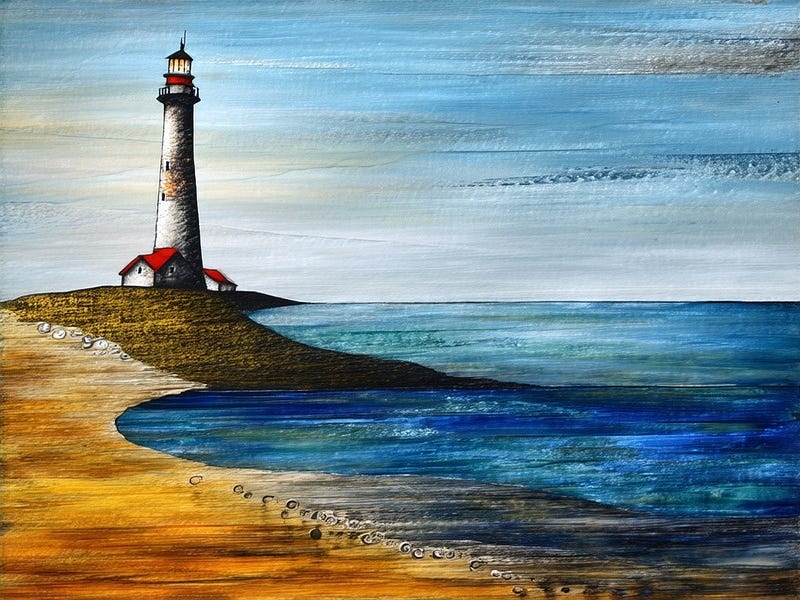
His painting this year was unlike anything he had tried before. Instead of chasing conventional beauty, Luca had focused on memories and imperfections—personal fragments anchored in an older Europe that he still held dear. He chose as a subject a half-ruined lighthouse on a remote island off the coast of Brittany. He remembered a trip taken years ago, before Berlin, before the AI revolution. That day, gusts of Atlantic wind had rattled an old metal door. Crumbling plaster revealed layers of past paint jobs: chipped reds, salt-stained whites, even traces of distant blue. He recalled the smell of kelp drying on the rocks, and the watery sunlight that turned the horizon into pale gold. These sensations were his secret language, things no algorithm could fully reconstruct because they were inseparable from the subtleties of human memory—those warm uncertainties that defined him.
Luca spent hours mixing pigments, trying to capture the particular glare of sunlight hitting damp stone. He resisted the temptation to smooth every brushstroke into neat perfection. Instead, he embraced uneven textures. The canvas bore marks where he pressed too hard, where a tremor of his hand left unintended trails. He left faint traces of pencil underdrawings visible, hints of a creative process in flux. If asked, he would not have been able to explain precisely why this mattered so much. He only knew that the painting’s small imperfections felt like a truer reflection of his humanity than any flawless image he could conjure.
The Expo opened in early June. The gallery complex stood where old factories had once spewed coal dust into Berlin’s sky. Now it gleamed with glass and steel, a temple of contemporary aesthetics. Inside, visitors wandered through curated halls where works hung without labels indicating their origin. Traditional oil paintings, digital manipulations, interactive installations, AI-generated sculptures—all mingled under the same neutral lighting. Panels on the wall displayed QR codes: visitors could scan them for clues, but no definitive answers would be given until after the judging.
This year’s star attraction was “Aurelius-3,” the latest AI model developed by an international consortium of tech firms. Aurelius-3 had stunned critics by producing series after series of evocative abstract landscapes that seemed to hint at hidden narratives. Journalists declared these images a new frontier: an AI that not only imitated style but also evoked an emotional arc. Rumor had it that Aurelius-3 fed on centuries of European art—digitized paintings, sketches, sculptures—extracting patterns and recombining them into forms that struck viewers as hauntingly familiar yet somehow beyond era or school.
Luca’s painting was displayed in a modest side gallery, hung between what looked like a digital collage of shifting colors and a sculpted head made of layered polymer. His work: a dim shoreline, a leaning lighthouse, and a subtle interplay of grays, ochers, and mossy greens. Up close, one could see coarse brush hairs stuck in the paint, and areas where pigments were unevenly blended. To the casual observer, it might look old-fashioned, even incomplete. Yet some visitors stopped longer before it. A young French student studying art history frowned thoughtfully. A Polish retiree, recalling her childhood summers by the Baltic Sea, lingered, surprised by a quiet ache rising in her chest. An Italian couple paused, reading the painting’s mood as a letter from a forgotten past.
Nearby, Aurelius-3’s entry glowed on a large screen. Its colors were exquisite, shimmering transitions from gold to azure, every pixel placed with intention. It resembled an ancient tapestry and a futuristic cityscape at once—impeccably balanced, expertly composed. Visitors marveled at its intricacy. Journalists snapped photos, preparing articles about the inevitable triumph of machine aesthetics. Luca felt a pang of fear and envy when he glimpsed that masterpiece. How could his flawed hand compare with such effortless beauty?
The judging took place behind closed doors. A panel of three humans—two renowned critics from Paris and Milan, and a curator from Stockholm—worked alongside three AI judges whose algorithms evaluated color harmony, compositional balance, and even the emotional responses captured by discreet facial recognition scans of visitors. The humans might champion meaning and narrative; the AI would reward internal consistency and statistically proven engagement metrics. The final decision balanced these perspectives.
When the winners were announced, Aurelius-3’s entry predictably took a top prize. The news spread quickly. Many hailed it as a new Renaissance—cold calculation birthing art that moved the masses. Human artists who had tried to mimic AI techniques or chase trending styles fell behind, outpaced in a race they could not win.
But that was not the whole story. In a surprising twist, the judges singled out Luca’s painting for a special mention. It did not score highest by aesthetic metrics, nor did it cause a surge in social media chatter. It was, by all quantitative measures, unremarkable. Yet one of the human judges, the curator from Stockholm, spoke in glowing terms about it: “This piece,” she said, “is stubbornly personal. It embraces imperfection and the quiet loneliness of memory. Its roughness is not a flaw but an invitation to reflect on time and loss. In an era when most images aim for instant perfection, here is a painting that resists easy consumption. I find that deeply moving.”
These words did not trigger a standing ovation from the crowd. Many barely noticed. But Luca, listening from the back of the gallery, felt his heart lighten. His work had connected with someone who understood its language. The mention carried no major prize money, but it was validation of a different kind—a small beacon of hope.
After the ceremony, Luca stepped outside. Evening had settled over Berlin, the sky brushed with pink and violet shades. The city hummed with life: trams rattled by, cyclists maneuvered through narrow streets, and laughter drifted from corner cafés. It struck Luca that art, human or AI, was but one part of this vast tapestry of existence. Machines might analyze centuries of masterpieces and produce dazzling works in seconds, but they could not replace the simple reality of standing here, breathing the mild summer air, feeling the weight of history and personal memory. The older Europe hidden between cobblestones and peeling plaster still mattered—because it mattered to him, and by painting it, he mattered to someone else.
Luca decided he would return to that Breton coast someday. He would revisit the lighthouse, see how it had weathered the passing years. Perhaps it had collapsed further, or maybe someone had restored it. In either case, the truth of that place—its smell, its texture, its intangible resonance—belonged to the world of lived experience rather than perfect renderings. He understood now that his painting was not merely an image; it was a record of a human journey, one that did not need to be the brightest or boldest. It only needed to be honest.
In the weeks to come, a handful of critics wrote short pieces about Luca’s painting. They debated whether humanity’s future in the arts would be found in fearless experimentation that accepted imperfection as a virtue. Luca did not cling too hard to these debates. Instead, he painted more, trusting the subtle imperfection of his hand and the quiet force of his memories. He realized that art was never solely about competing with perfection—human or digital. Rather, it was about finding meaning, forging connections, and leaving behind traces of one’s journey.
In the heart of Europe, where centuries of art still whispered from old galleries and cathedrals, Luca embraced his role in this evolving story. The world was changing. Yet, in that change, he found a small but unshakable truth: imperfection was not failure—it was the signature of being alive, of leaving a human imprint that no machine could fully erase.
What Impressed Me During Writing
While writing this version, I was struck by how the tension between artificial intelligence and human creativity can inspire a deeper appreciation for imperfections, memories, and personal experiences that algorithms cannot fully replicate. Setting the story in Europe allowed for a rich cultural backdrop, evoking centuries-old traditions of art and beauty. The human painter’s struggle highlights that true artistic value may lie not in flawless execution or instant appeal, but in honest expression and the subtle resonance that only lived, imperfect experiences can bring forth. In the end, I was most impressed by the idea that imperfection itself can be a source of inspiration and meaning in a world increasingly drawn toward polished, machine-made outputs.
コメントを残す