April 2025 Latest Edition: The Frontline of AI Revolution! Comprehensive Summary of Major Companies’ Latest Updates
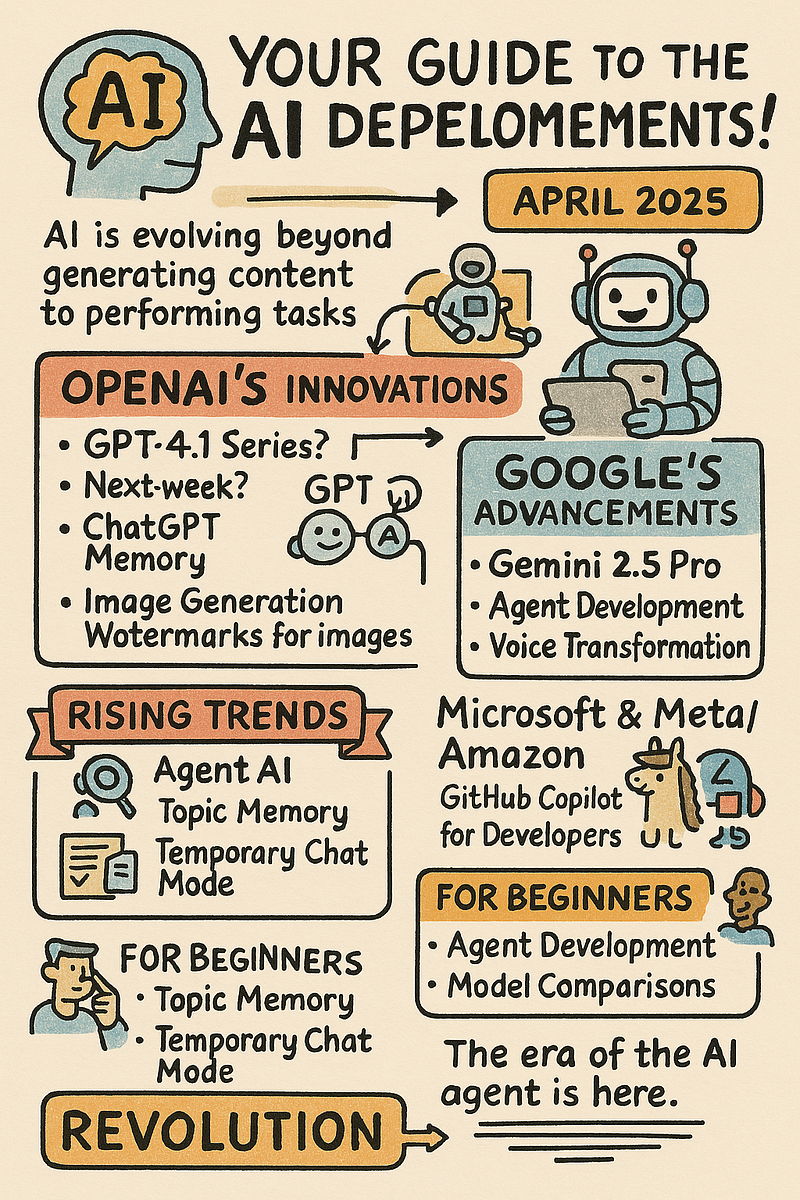
AI technology has reached a significant turning point in April 2025. Beyond traditional question-answering and content generation, “agent” technology that automates actual tasks has become mainstream. This article explains the latest AI tool updates in detail for everyone from beginners to advanced users.
OpenAI’s Latest Innovations
Potential Release of GPT-4.1 Series
– Breaking news: OpenAI may announce new AI models “GPT-4.1” and its smaller versions as early as next week
– Expected to be the next-generation model that further evolves GPT-4o released last year
– In addition to GPT-4.1, resource-efficient versions “GPT-4.1 mini” and “GPT-4.1 nano” may also be released simultaneously
ChatGPT’s Memory Function: Evolution of Personalization
– New feature that remembers all your past conversations to provide more personalized responses
– This feature will first be available to ChatGPT Pro and Plus users, excluding certain regions (UK, EU, Iceland, Liechtenstein, Norway, Switzerland)
– Privacy considerations: Users can opt out or choose temporary chat mode
Balance Between Image Generation and Safety
– Developing technology to automatically add watermarks to AI-generated images
– “ImageGen” watermark feature being tested in the beta version of ChatGPT’s Android app
– Content moderation policy also relaxed: Now allows generation of public figures’ images and potentially controversial symbols
Expanded Investment in Agent Technology
– Launched new AI agent building tools for enterprises as “Responses API”
– Traditional “Assistants API” scheduled for retirement in early 2026
– Specialized AI agents to be offered as premium services priced at $2,000-$20,000 per month
Google’s Comprehensive AI Solutions
Gemini 2.5 Pro: The Thinking AI
– Google’s cutting-edge AI model moves to public preview stage
– Implements “thinking process”: Displays reasoning steps before answering complex questions
– Comprehensively processes multimodal inputs (text, voice, images, video)
– Supports a vast context window of 1 million tokens (expandable to 2 million tokens in the future)
Development of Agent Infrastructure
– “Agent Development Kit (ADK)”: Open-source framework for building AI agents
– “Agent2Agent (A2A) Protocol”: Standard enabling secure communication between AI agents
– Expansion of “Agentspace”: Provides access to enterprise search, no-code development, and specialized agents
Google Workspace’s Intelligent Productivity Enhancement
– Voice conversion feature in Google Docs: Enables creation of complete audio versions of documents and podcast-style summaries
– “Help me refine”: New AI writing tool that polishes your text
– Enhanced Sheets: AI automatically analyzes data and visually presents important insights
– “Workspace Flows”: Tool for creating agent workflows that automate repetitive tasks
Microsoft & GitHub’s Developer Experience Improvements
GitHub Copilot’s Agent Mode
– Introduced Copilot agent mode for VS Code
– Understands entire projects and suggests appropriate terminal commands and error analyses
– Acquired ability to automatically complete subtasks spanning multiple files
Microsoft Copilot’s Personalization Features
– Evolved from a mere AI assistant to a “personalized” AI companion
– Feature that learns your preferences and lifestyle details from conversation history
– “Deep Research” function: Automatically executes multi-step research tasks
– “Actions” function: Performs tasks like ticket bookings and restaurant reservations
Meta & Amazon’s Progress in Open Source and Voice AI
Meta’s Open Source Strategy: Llama 4
– Announced two new models “Llama 4 Scout” and “Llama 4 Maverick”
– Multimodal AI system capable of processing text, images, voice, and video
– Planned for free distribution to researchers and developers, with large-scale “Llama 4 Behemoth” also in development
Amazon’s Voice AI Revolution: Nova Sonic
– Latest voice model added to Amazon’s “Nova” family
– Groundbreaking design integrating voice understanding and generation into a single model
– Dynamically adjusts responses based on the prosody (intonation and rhythm) of input voice
– Supports enterprise voice AI application development via Bedrock
Practical Analysis of 2025 AI Trends
Rise of Agent AI
– 2025 marks a turning point where AI evolves from “chat” to “task execution”
– Automates entire workflows across various industries including legal, marketing, development, and customer support
– “Agents”: AI that can autonomously execute multiple steps toward specific goals
Standardization of Multimodal AI
– Models capable of processing text, images, voice, and video across platforms become mainstream
– Achieves more natural interfaces by handling multiple input/output formats within a single AI system
Improved Transparency in AI Content Generation
– Watermarking technology for AI-generated content: Efforts to ensure reliability of information sources
– Google’s quality evaluation criteria: AI-generated content may be rated as low quality without human supervision
For Beginners: Key Points for Utilizing the Latest AI
How to Maximize ChatGPT’s New Features
– Memory function: Utilize memory function when frequently asking questions about the same topic
– Privacy considerations: Recommended to use temporary chat mode for confidential conversations
– Image generation tips: Use detailed prompts and specific instructions according to your purpose
Utilization Methods for Google Workspace Users
– Docs voice conversion: Convert long reports into audio content for multimedia expansion
– Sheets data analysis: Quickly extract important insights by having AI analyze complex datasets
– Workspace Flows: Delegate routine repetitive tasks to agents and focus on creative work
For Advanced Users: Technical Utilization of Cutting-Edge AI
Getting Started with Agent Development
– Google’s Agent Development Kit: First choice when building your own agents
– Agent2Agent Protocol: Ideal for systems requiring collaboration between multiple AI agents
– OpenAI’s Responses API: Recommended for cases requiring advanced reasoning capabilities and powerful tool integration
Benchmark Comparison of Latest Models
– Reasoning ability: Gemini 2.5 Pro and GPT-4.1 (planned) expected to demonstrate cutting-edge reasoning capabilities
– Context processing: Gemini 2.5 Pro’s 1 million token capacity gives it an advantage in document processing
– Multimodal processing: GPT-4o, Gemini 2.5 Pro, and Llama 4 each have different characteristics
Summary: AI Outlook for 2025
As of April 2025, AI has evolved significantly from “mere answer generation” to “autonomous task execution.” Particularly noteworthy is the development of agent technology, making automation of complex workflows a reality.
Major players like OpenAI, Google, Microsoft, Meta, and Amazon are evolving AI technology through different approaches, but common trends include:
1. More personalized user experiences
2. Standardization of multimodal input/output
3. Automation of practical tasks through agent technology
4. Expansion of massive context windows
These technologies have the potential to enhance productivity and creativity for all users, from beginners to advanced. To effectively utilize AI tools, it’s important to regularly check for updates and identify the tools best suited to your workflow.
2025 will mark the beginning of a true AI revolution. Now is the time to strategize how to incorporate AI into your business and daily life.
コメントを残す