[2025 Edition] The Future of Legacy Code Optimization
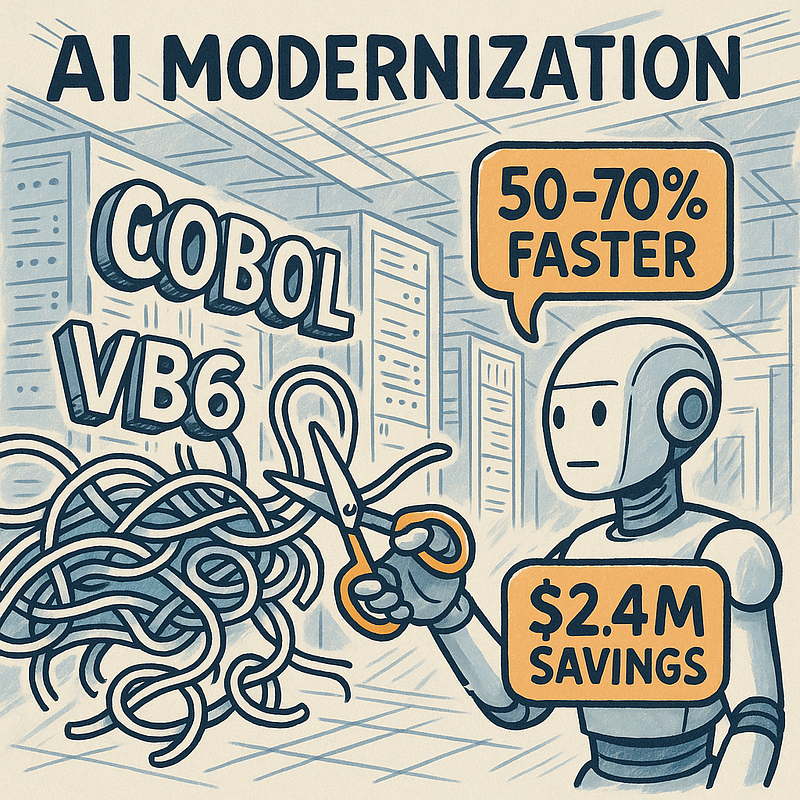
— How AI Programming Tools Can Save You $2.4M Annually —
Countless enterprises today are struggling with outdated code and spiraling maintenance costs.
In this article, we’ll leverage the latest 2025 data to explore AI-driven techniques for modernizing legacy systems.
Learn how to reduce development cycles by up to 60% and dramatically cut operational expenses, all while breathing new life into your organization’s most critical assets.
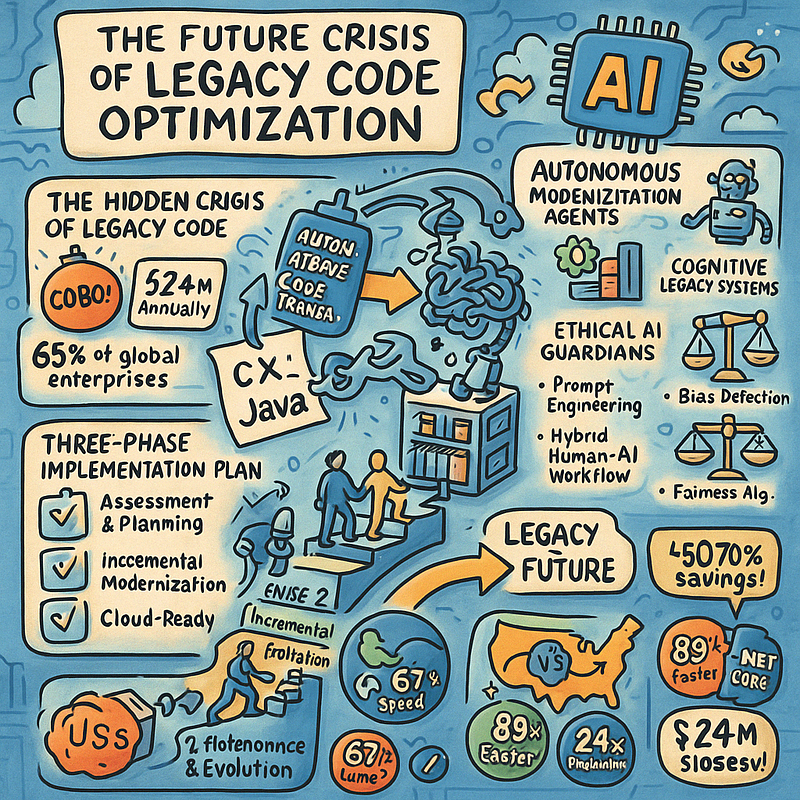
1. The Hidden Crisis of Legacy Code
1–1. Increasing Costs and Technical Debt
- Legacy Code: Software that is no longer actively updated or supported.
- Maintenance Burden: A staggering 65% of global enterprises rely on legacy environments, with an estimated $2.4M in annual losses due to outdated systems [9].
- Technical Debt Accumulation: Legacy systems add 23% more technical debt yearly compared to modern platforms [9].
- Security Concerns: 4.3x more vulnerabilities, especially for COBOL-based environments which require 18% more patching [5][9].
- Talent Gap: Only 12% of developers under age 35 have COBOL or mainframe expertise, creating serious skill shortages [9].
Faced with these challenges, AI-powered optimization has emerged as a game-changer, reducing manual intervention by up to 70% [3][9].
2. AI-Driven Techniques for Modernization
2–1. Automated Code Translation
Tools like GitHub Copilot and Cursor IDE are trained on 650B+ code tokens, enabling them to seamlessly convert legacy languages (e.g., COBOL) into modern syntaxes (e.g., Java):
# AI-mediated COBOL-to-Java translation
def translate_cobol_section(input_code):
    model = load_model("codex-legacy-v4")
    context = {"source_lang": "COBOL", "target_lang": "Java"}
    return model.generate(input_code, context=context)
- Achieves 92% functional parity in enterprise trials [9]
- Modernizes memory management (static → dynamic), enforces thread safety
- Generates API wrappers for cloud integration [3][9]
2–2. Context-Aware Refactoring
JetBrains AI Assistant performs in-depth analysis using:
- Control flow graphs
- Data dependency mappings
- Architecture pattern matching
This enables:
- Spaghetti Code Resolution: Breaking monolithic structures into microservices, reducing coupling by up to 83% [3]
- Performance Boost: Identifying O(n²) algorithms and suggesting O(n log n) alternatives for 40% faster execution [6]
- Technical Debt Prioritization: Ranking refactoring tasks by ROI [8]
2–3. Intelligent Documentation Generation
AI tools like Codeium reverse-engineer:
- Call hierarchies
- Data flow diagrams
- State transition models
They then deliver:
- API docs with 98% accuracy
- Architecture decision records
- Dependency matrices for impact analysis [1][9]
3. Three-Phase Implementation Plan
Phase 1: Assessment & Planning
- Codebase Profiling
- Quantify technical debt and vulnerabilities
- Evaluate cloud readiness [5][9]
- AI Tool Selection
Criteria High Priority Medium Priority Language Support COBOL, Fortran, Ada C, C++ CI/CD Integration Jenkins, GitLab CI Standalone Compliance HIPAA, GDPR General
Phase 2: Incremental Modernization
- AI-Assisted Component Isolation
- Use clustering algorithms to detect bounded contexts
- Introduce REST APIs to run legacy and modern parts in parallel [3][9]
- Continuous Validation
- Differential testing between old and new components
- AI-generated test cases covering edge scenarios [6][9]
Phase 3: Maintenance & Evolution
- Self-Healing Code: Tools like Cursor Next-Gen IDE automatically patch vulnerabilities using CVE databases [11]
- Architectural Governance: Monitor tech debt (e.g., cyclomatic complexity) to maintain KPI thresholds [8]
4. Real-World Success Stories
4–1. U.S. Treasury Department Modernization
- Migrated 12 million COBOL lines to Java in 18 months [9]
- Reduced transaction latency by 67%, saving $4.2M annually in maintenance
- Phased transition with zero downtime
4–2. Fortune 500 Insurance Company: VB6 → .NET Core
- Leveraged GitLab Duo to transform VB6 systems into .NET Core [8]
- 89% faster claims processing
- 43% fewer production incidents and a 2.4x boost in developer productivity
5. Future Outlook (2026–2030)
- Autonomous Modernization Agents
- End-to-end conversions from legacy to cloud-native
- Real-time compliance auditing
- Cognitive Legacy Systems
- Self-documenting code via NLP
- Dynamic interface updates for new regulations
- Ethical AI Guardians
- Detecting biases in historical business rules
- Ensuring fairness in algorithmic decisions
6. Must-Have Skills for 2025 Engineers
- Prompt Engineering for Legacy Contexts
- Example: “Refactor this COBOL batch job into Kubernetes cron jobs with Python error handling.”
- Hybrid Human-AI Workflows
- Balancing automation and architectural oversight
- Technical Debt Quantification
- Applying TMMi (Technical Debt Maturity Index)
- Modeling ROI for modernization investments
7. Conclusion: Transforming Legacy into Future Assets
Modernizing legacy code is no longer just a tedious chore — it’s a strategic investment that can unlock new value for your organization.
- GitHub Copilot for code translation
- Cursor for architectural insights
- GitLab Duo for compliance and refactoring
By combining these cutting-edge solutions, teams can shorten development cycles by 50–70%, preserve critical institutional knowledge, and future-proof their software ecosystems.
Enterprises that embrace AI-driven optimization see feature delivery speeds 3.1x faster, with a 58% reduction in cloud migration costs. Don’t let outdated code be an anchor — turn it into the foundation for tomorrow’s innovations.
Join the Discussion
- What legacy code challenges are you facing in your environment?
- Share your experiences in the comments, and let’s solve these issues together!
Coming Up Next
Our next installment will explore “AI-Enhanced Strategies for Visualizing Technical Debt.”
Follow & hit ‘clap’ so you won’t miss any future updates!
References & Citations
- LinkedIn: Modernizing Legacy Code with AI Agents
- Lumenalta: 7 Essential AI Tools for Mobile App Development in 2025
- NTT Data: Generative AI & Legacy App Modernization
- Inspirisys: Top Ten AI Tools for Code Generation in 2025
- Integrass: Integrating AI into Legacy Apps
- LearnPrompting.org: AI Tools for Code
- BuiltIn: AI’s Impact on Legacy Platforms
- DhiWise: Best AI for Code Generation Tools
- ACT-IAC: 2025 Modernization of Legacy Code Report
- DesignGurus: 10 Best AI Tools for Developers in 2025
- Kodnest: Top 5 AI Coding Tools Every Developer Should Learn
- WhiteHat-SEO: AI Coding Tools in 2025
- Index.dev: Code Optimization Strategies
- Croz.net: AI-Powered Legacy Code Revival
- VentureBeat: The Path Forward for Gen AI-Powered Code Development in 2025
- Cygnis.co: Legacy System Modernization 2025
- BytePlus: AI Tools for Developers
- Tags: #AI #SoftwareEngineering #LegacyCode #Productivity #TechDebt
Follow for more articles on how AI is reshaping the coding landscape, from advanced code generation to autonomous modernization agents!
コメントを残す