When aiming for $10,000 a month in blogging and content monetization, the highest hurdle is the continuous production of high-quality, perfectly optimized articles.
In the past, you needed a fragmented workflow: researching SEO keywords, building outlines, writing, sourcing images, formatting Markdown, and finally uploading to WordPress. However, as of 2026, the rise of autonomous AI agents has transformed this entire process into a single, fully automated, end-to-end pipeline.
In this article, I will break down the exact AI workflow and tool stack I used to build a content business with over 700,000 page views, allowing me to focus entirely on strategy while the agents handle the execution.
Why You Need an End-to-End Automated Pipeline
To scale revenue through AdSense, affiliate marketing, and direct sponsorships, you must maximize both speed and quality. Previously, using conversational AI like ChatGPT only optimized the writing phase. Creators were still losing hours manually handling the surrounding friction: creating visual assets, writing alt texts, configuring SEO metadata, and formatting HTML for WordPress.
By delegating the entire pipeline—from research to WP publishing—to an AI agent, you unlock the ability to focus only on the most valuable tasks: topic selection and monetization strategy.
The Complete Automation Workflow
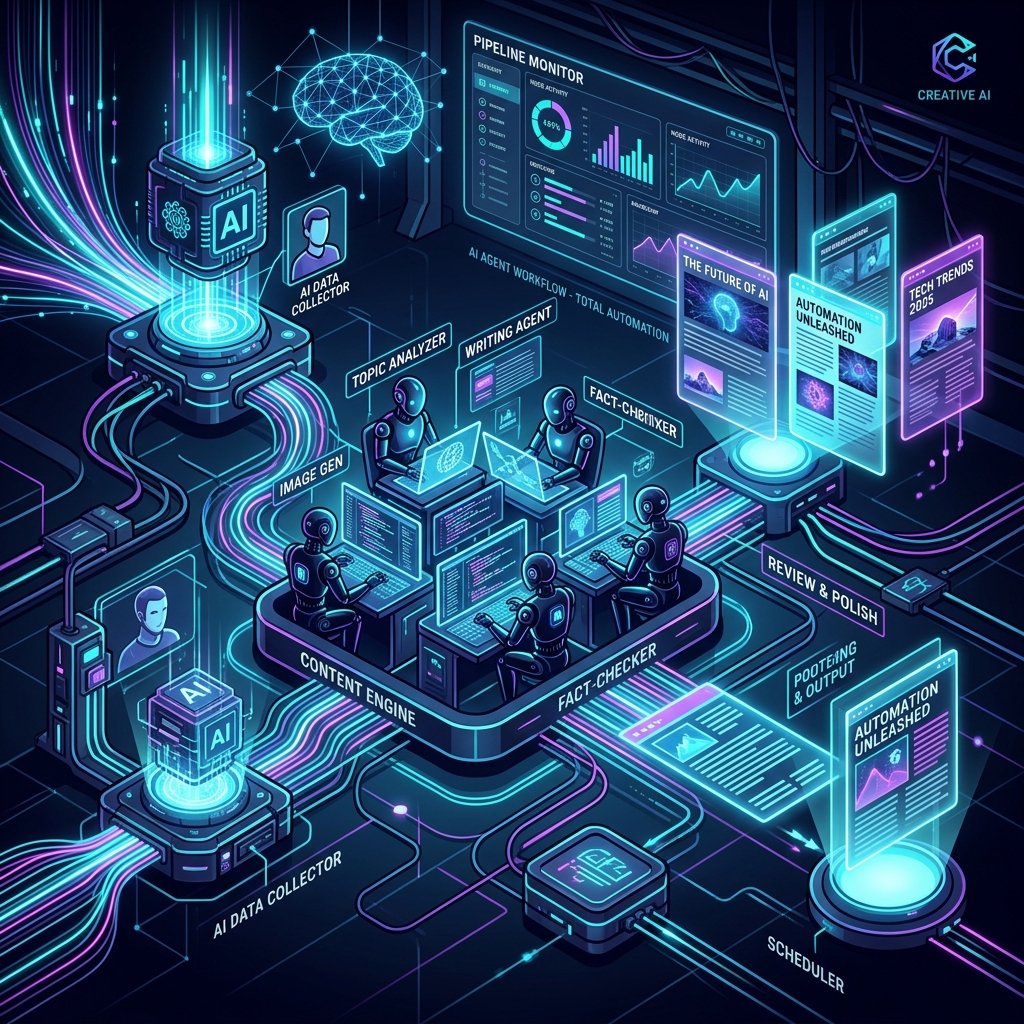
The actual mechanics of the pipeline look like this:
graph TD
    A[User Input] -->|Provides Topic or Keyword| B(AI Agent Initiation)

    subgraph AI Autonomous Pipeline
    B --> C[🌐 Web Search & Trend Research]
    C --> D[✍️ Long-form Markdown Drafting]
    D --> E[📊 Mermaid Diagram Generation & Alt Text Injection]
    E --> F[🖼️ High-Quality Eye-catch Image Generation via Prompts]
    F --> G[🏷️ Comprehensive SEO Meta Data JSON Creation]
    end

    G -->|Metadata + Images + Markdown| H(REST API Transmission to WordPress)
    H --> I[🚀 Automatic Article Publish]
1. Research (Web Search)
When given a target keyword, the AI agent autonomously performs internet searches to gather the latest real-time data for 2026. This prevents hallucination and ensures that the article references up-to-date tools, prices, and frameworks rather than outdated training data.
2. Drafting and Visual Asset Insertion
Using the researched data, the agent drafts content structured to maximize session duration—a key metric for SEO ranking. To prevent the post from becoming a massive wall of text, the AI dynamically inserts tables and [Mermaid Markdown diagrams] to visually explain complex workflows.
Crucially, every image and diagram receives a perfectly optimized Alt text attribute, capturing additional organic traffic from Google Image Search and ensuring high web accessibility scores.
3. Automated Eye-Catch Image Generation
Instead of relying on generic stock photos, the AI creates its own custom prompt based on the article's core theme. It then utilizes underlying image generation models to create a sleek, modern, tech-oriented thumbnail. Maintaining this high-quality "cyberpunk / modern tech" aesthetic establishes strong brand uniformity across the entire blog.
4. SEO Metadata Generation
The agent extracts the essence of the article and packages it into a strict meta.json file format containing:
- SEO Title: An optimized headline kept strictly under 60 characters to capture search volume.
- Slug (Permalink): Clean, English-based URL routing (e.g.,
ai-blog-automation-2026). - Meta Description: A compelling excerpt designed specifically to trigger clicks from Search Engine Results Pages (SERPs).
5. Seamless WordPress Publishing via REST API
All generated assets (images, Markdown, metadata) are bundled together and sent directly to the live WordPress server via the REST API with a single click. There is absolutely no need to manually log into the WP-Admin dashboard to copy, paste, or upload media files.
2026 AI Tool Stack: Powering the Pipeline
To run this full-auto pipeline, selecting the right underlying models is critical:
- Claude 3.7 / Claude Code (Anthropic)
The unquestioned leader in reasoning and coding capabilities. Claude is the primary brain used for writing the execution scripts (Node.js REST API handling) and ensuring the flawless orchestration of the entire pipeline. - DeepSeek / Qwen (Open Source Models)
These are crucial for cost optimization. By routing lighter tasks—like basic proofreading, tag extraction, or formatting JSON—to these affordable models, you can compress your monthly operational costs to under $20, keeping profit margins massive. - Gemini 1.5 Pro CLI
Thanks to its deep Search Grounding integration, Gemini excels as the dedicated "Research Agent," rapidly scraping the web for the absolute latest developments and feeding them back to the main writing agent.
Conclusion: Focus on Architecture, Not Labor
When trying to cross the $10,000/month threshold, manual execution is no longer sustainable.
Whether you need to generate essential legal pages, optimize 500 legacy articles with new meta titles, or cover breaking AI news within minutes, we are living in an era where you only need to give an AI agent a single instruction to execute multi-step projects.
By establishing this autonomous content pipeline, you can reclaim your time and focus exclusively on high-leverage activities, such as direct sponsor outreach and community building.

コメント