Why the Most-Read Writers in 2026 Are Getting Less AI-Assisted, Not More
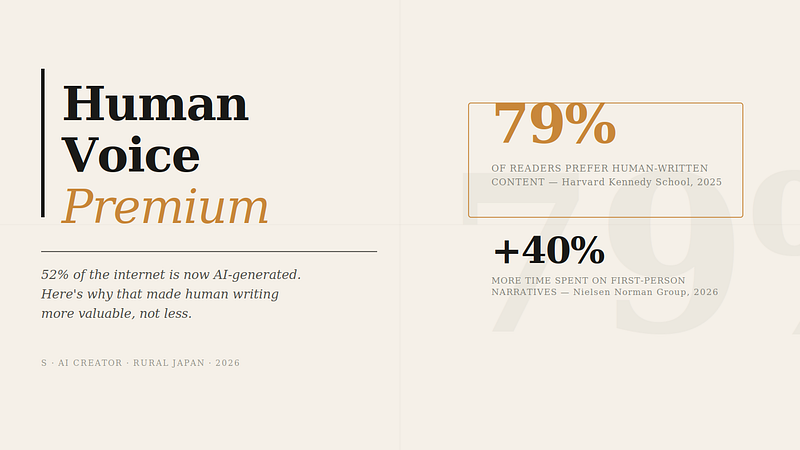
By early 2026, something interesting had quietly happened to the internet. AI-generated text now accounts for an estimated 52% of web content, and readers have noticed. A backlash term has entered common usage — “AI slop” — describing the wave of technically correct but experientially hollow content that has flooded feeds, inboxes, and search results.
The paradox this creates for content creators is worth examining carefully, because it represents a genuine market opportunity hiding inside what looks like a threat.
What the Data Actually Shows
The numbers are striking. A Harvard Kennedy School study published in late 2025 found that 79% of readers actively preferred content they perceived as human-written, even when they could not reliably identify the difference in blind tests. Nielsen Norman Group’s latest eye-tracking research confirms that readers spend 40% more time on first-person narrative passages compared with third-person informational structures — the default output mode of most AI writing assistants.
This creates a structural asymmetry. As AI-generated content becomes the median, human-authentic content captures the premium end of attention. The supply of technically competent prose has exploded; the supply of writing that carries genuine experience, perspective, and intellectual risk-taking has not.
What “Human Voice” Actually Means in Practice
This concept risks becoming vague quickly, so let me make it concrete. Human voice is not about avoiding AI tools. It is about what you bring that a language model cannot: lived specificity, productive uncertainty, and stakes.
Lived specificity means referencing the actual Tuesday afternoon when something failed, not a generic narrative of professional challenge. It means knowing that your reader in Tokyo is worried about a slightly different version of the same problem your reader in Berlin has — and being willing to acknowledge that gap rather than smoothing it over.
Productive uncertainty is rarer still. Most professional writing suppresses doubt in favor of authority. But readers are increasingly sophisticated at detecting false certainty, and a writer who says “I’m not sure this framing is right, but here is why I keep returning to it” generates more trust than one who presents every conclusion as settled.
Stakes means the writer has something at risk in the argument. A recommendation that costs the writer nothing to make carries less weight than one made from a position of actual accountability.
The Practical Implication for Content Strategy
If you are creating content professionally — whether for note.com, Medium, Substack, or a corporate blog — the strategic implication is clear. AI tools are most effectively used as research accelerators and structural editors, not as voice generators.
The workflow that emerges from this: use AI to compress the research and organizational phase, then write the section that requires your genuine perspective in your own words, unassisted. The ratio matters. When AI handles the scaffolding and humans inhabit the structure, the output tends to read as neither purely AI nor awkwardly hybrid.
One Japanese content platform, note.com, reached 10.52 million registered users in 2025 and has since implemented AI writing assistance. The creators gaining traction there are not the ones who write fastest; they are the ones whose content cannot be easily replicated by running a prompt. Personal experience as a primary source has become a genuine competitive moat.
A Note on the Market Dynamics
What is happening is a classic bifurcation. Commodity content — summaries, explainers, directory pages — will increasingly be produced by AI at near-zero marginal cost. Differentiated content, built on expertise, experience, and clear editorial perspective, will command a growing attention premium.
This bifurcation is not hypothetical. Newsletter open rates for established personal brands outperformed generic content aggregators by a factor of 3.2 in Q4 2025, according to Mailchimp’s benchmark report. Readers are sorting actively, not passively. They are subscribing to people, not topics.
The implication for anyone building a writing practice today is this: invest your irreplaceable hours in the parts of the work that only you can do. Let AI handle what it does efficiently. The writers who figure out this boundary — where the tool ends and the voice begins — will hold a durable advantage over the next several years.
The Question Worth Sitting With
Before you open an AI tool for your next piece of writing, it is worth spending two minutes on a simple question: what is in this article that could only come from me? Not from my research, not from my summary of others’ ideas, but from my specific vantage point, my particular failures and recoveries, my genuine uncertainty about the thing I am claiming to know.
If the answer is nothing, the article is probably worth reconsidering before you invest more hours in it. If the answer is something concrete — a story, a counter-intuitive conclusion drawn from your own data, a position you are willing to defend — then you have the seed of something AI cannot easily replicate.
In a market flooded with competent prose, that seed is worth more than it has ever been.
I write about AI tools, content strategy, and the changing economics of creative work. This piece draws on research from Harvard Kennedy School (2025), Nielsen Norman Group (2026), and Mailchimp’s Email Benchmarks Report Q4 2025.
If this was useful, follow me here on Medium.
I’m S — a content creator and AI practitioner based in rural Japan (Shimane Prefecture). I publish practical, honest takes on AI tools, content monetization, and what it actually looks like to build income with these tools from outside a major city.
Tags: Artificial Intelligence Content Creation Writing Creator Economy AI Tools

コメント