Google I/O 2026 was not just another model announcement event. The bigger story is that Google is trying to move AI from "answer this question" to "help me build, monitor, create, and act across my workflow."
That is why the most interesting announcements are not only the new Gemini model names. For me, the exciting parts are Google AI Studio and Gemini Omni. AI Studio is becoming a faster path from idea to working app. Gemini Omni points toward a future where text, images, and video become one creative surface.
The practical shift is simple: Google is turning Gemini from a chat assistant into an agent layer for building, searching, creating, and daily work.
This article is based on Google's official I/O 2026 announcements published on May 19, 2026, with interpretation clearly separated from confirmed facts.
Short Answer
At Google I/O 2026, Google announced a broad agentic AI push across Gemini, Search, AI Studio, Google Flow, Android, Chrome, and developer tools.
The key updates:
- Google AI Studio gained Workspace integrations, mobile app pre-registration, native Android app building, in-browser emulator support, Play Store Internal Test Track publishing, and easier deployment.
- Gemini Omni was introduced as a model for turning text, images, and video prompts into high-quality video outputs, with rollout beginning for Google AI Plus, Pro, and Ultra subscribers.
- Google Flow received Gemini Omni Flash, Flow Agent, and natural-language custom tools.
- Gemini Spark was announced as a 24/7 personal AI agent, first rolling out to trusted testers and then planned as a beta for U.S. Google AI Ultra subscribers.
- Search is getting agentic features, including information agents, agentic booking, and custom generative UI experiences.
- The developer keynote emphasized managed agents, Antigravity 2.0, the Gemini API, and AI Studio as part of a broader agent-building stack.
The direction is clear: Google wants AI to become an operating layer, not a separate chatbot tab.
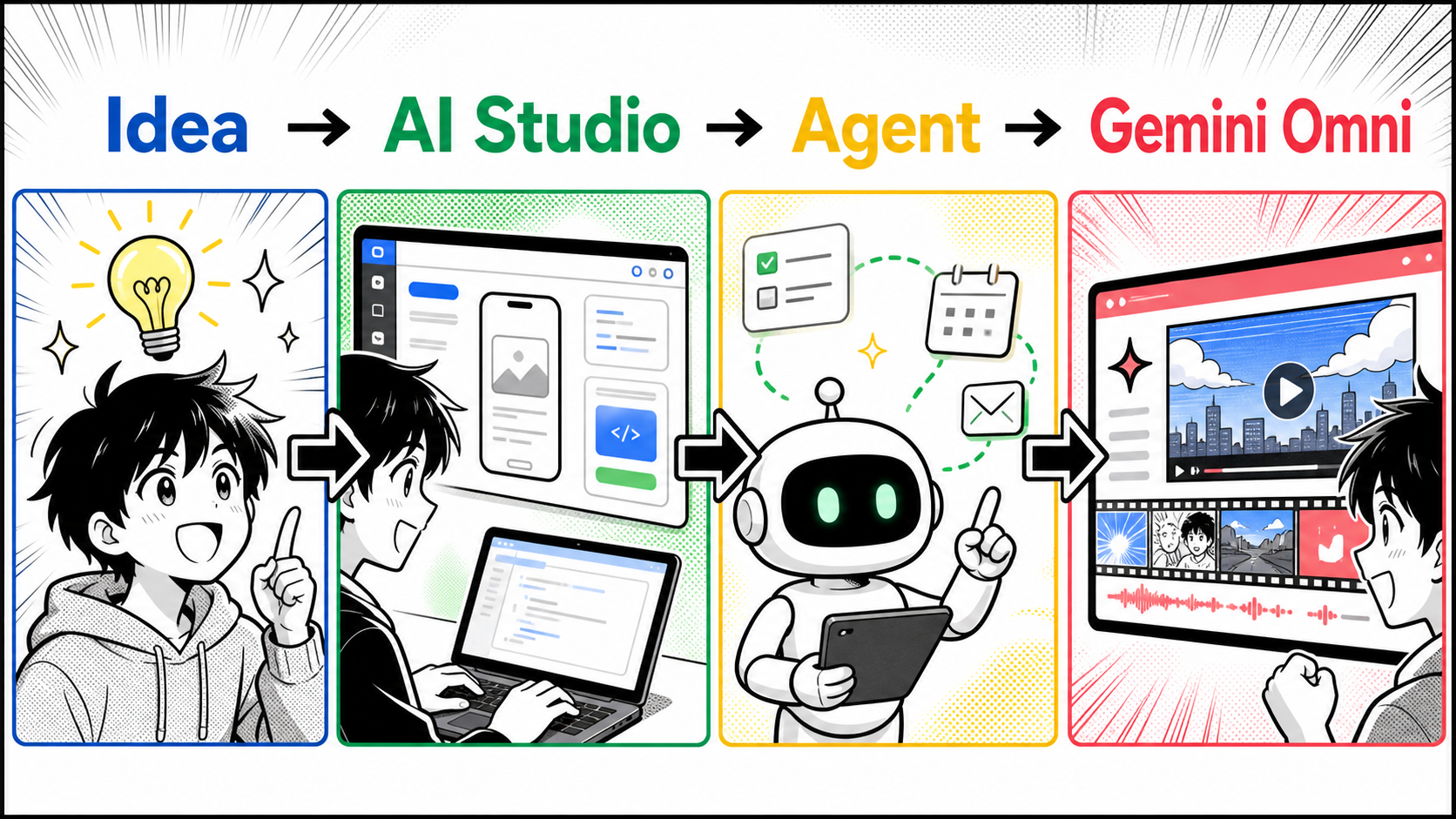
Why Google AI Studio Matters
Google's official AI Studio announcement says the product has become "the fastest path from prompt to a production app" for millions of builders. The new I/O 2026 updates push that idea further.
The most practical update is Workspace integration. Apps built inside AI Studio can now access Google Workspace directly. That means builders can create dashboards on Sheets data, tools for organizing Drive, and apps that work with team documents without leaving AI Studio.
AI Studio also now exports project state to Google Antigravity. Google says conversation history, project files, and secrets move with the export, so a prototype can continue into a larger local or team development workflow.
For design, AI Studio's Build agent can generate custom images through Nano Banana, and the preview window now supports annotation and editing. That matters because app building is rarely just "generate code." Real products need interface iteration, visuals, preview feedback, and handoff.
AI Studio is becoming less like a demo playground and more like a lightweight product workshop.
The mobile app announcement is also important. Google opened pre-registration for a Google AI Studio app, promising the full build-mode experience on a phone. If this works well, app prototyping becomes something you can start the moment an idea appears, then continue later at a desk.
The Android update may be the strongest signal. Google says AI Studio can now build native Android apps directly in the build tab: prompt the app, generate Kotlin with Jetpack Compose patterns, preview it in a browser-based Android emulator, use ADB, and publish to Google Play's Internal Test Track with one click.
That does not remove the need for engineering judgment. But it does reduce the friction between "I have an idea" and "I can test this on a real device."
Gemini Omni: Why It Feels Exciting
Gemini Omni is one of the announcements that makes the future feel closer.
In the Gemini app announcement, Google describes Gemini Omni as a model that can transform text, images, and video prompts into cinematic video outputs. It also says video editing becomes conversational: users can apply cinematic zooms, swap backgrounds, use built-in templates, and create AI avatars.
In the Google Flow announcement, Google describes Gemini Omni Flash as a model that starts with video, combines Gemini intelligence with generative media models, and improves world understanding, multimodality, precise video editing, character consistency, identity, and voice preservation.
This is the part that matters for creators: the boundary between writing, visual planning, editing, and publishing keeps getting thinner.
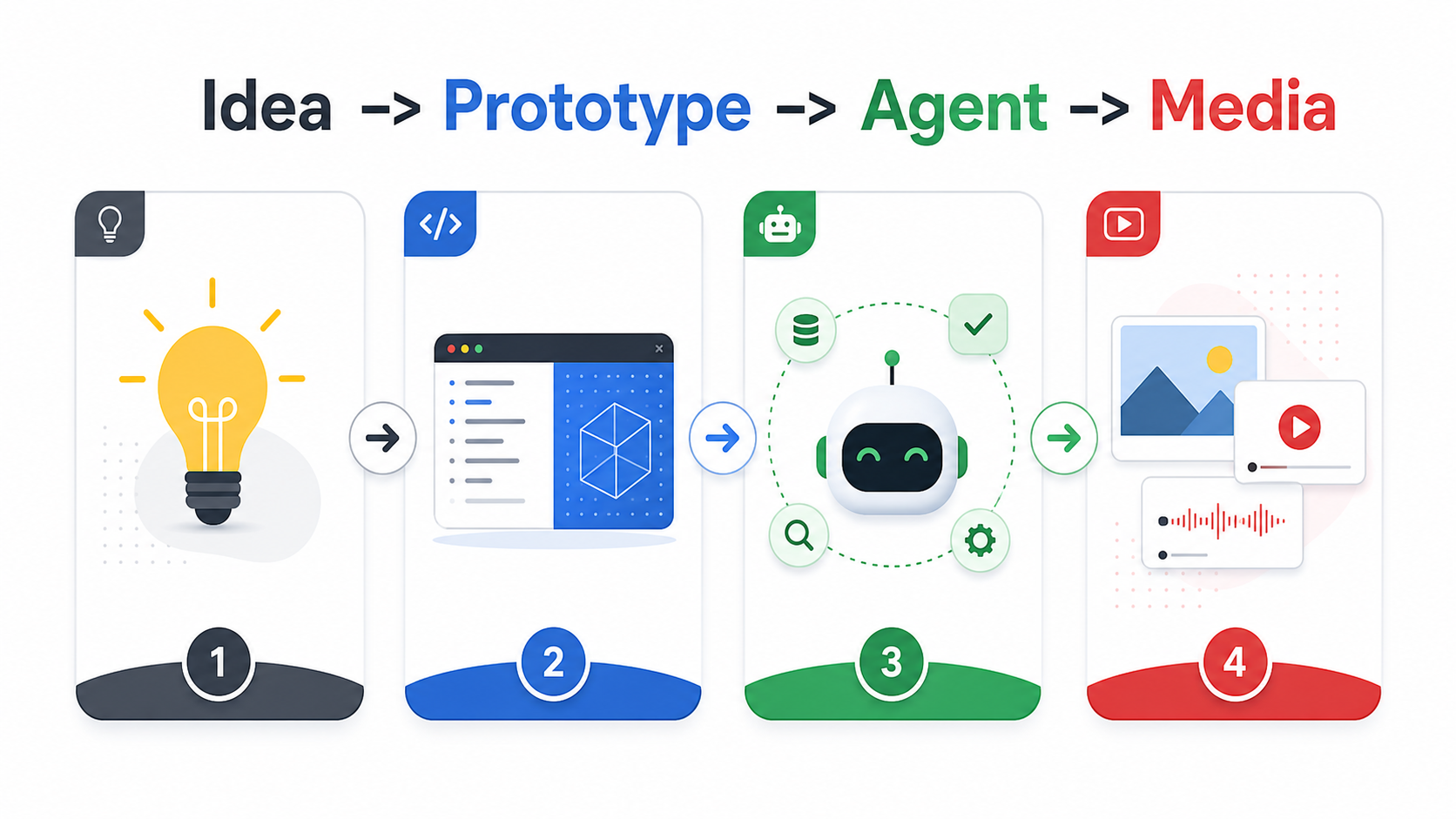
For a solo creator, a small business, or a writer who also needs thumbnails, short videos, tutorials, and social clips, Gemini Omni is not just "another video model." It is a sign that creative AI is becoming an editable workflow instead of a one-shot generation gamble.
The real promise of Gemini Omni is not only better video. It is conversational control over media production.
There are still open questions: quality, pricing pressure, regional availability, copyright handling, watermarking, and how reliable identity consistency will be in real projects. But the direction is easy to understand: generate, edit, iterate, and organize media with AI agents instead of juggling many separate tools.
Gemini Spark and the Move From Answers to Action
Google also announced Gemini Spark, a 24/7 personal AI agent. According to Google's Gemini app post, Spark is designed to help users navigate digital life under their direction. It runs on Gemini 3.5 and uses the Antigravity harness.
The examples are concrete:
- parse recurring statements to flag new subscription fees
- monitor school emails and extract deadlines
- synthesize raw meeting notes into Google Docs
- draft companion emails for a project kickoff
Google says Spark is cloud-based, so it can keep working in the background after a laptop is closed or a phone is locked. It is planned for trusted testers first, then as a beta for U.S. Google AI Ultra subscribers.
The safety detail matters. Google says Spark asks before high-stakes actions such as spending money or sending emails. That is the right boundary. The more useful agents become, the more important permission, auditability, and reversibility become.
Search Is Becoming Agentic Too
Search was another major part of the I/O 2026 story. Google's Search announcement says AI Mode surpassed one billion monthly users one year after its debut. Google also announced Gemini 3.5 Flash as the new default model in AI Mode globally.
The more interesting part is Search agents. Google says information agents will operate in the background, reason across web information and fresh data, and send synthesized updates. The first rollout is planned for Google AI Pro and Ultra subscribers in summer 2026.
Search is also adding agentic booking capabilities for local experiences and services, plus the ability for Google to call businesses on behalf of users in select U.S. categories.
For creators and publishers, this is a big change. Search is not only a page of links anymore. It is becoming a system that can monitor, summarize, build custom interfaces, and help users complete tasks.
If Search becomes more agentic, publishers need to create content that is useful enough to be cited, summarized, and acted on.
That means better source hygiene, clearer answers, stronger original experience, and content that solves specific tasks rather than generic keyword pages.
Developer Stack: AI Studio, Gemini API, Antigravity, Managed Agents
The developer keynote framed I/O 2026 around agents that can navigate complex tasks across workflows.
Google announced or highlighted:
- Antigravity 2.0 and Antigravity CLI for specialized subagents
- managed agents in the Gemini API with a remote sandbox
- AI Studio integrations with Android, Workspace, Firebase, Cloud Run, and Antigravity
- Android CLI and Android skills for agent-driven Android development
- a migration agent for converting app code into native Kotlin Android apps
- WebMCP as a proposed open web standard for exposing structured tools to browser-based agents
- Chrome DevTools for agents
The direction is practical: agents need tools, sandboxes, credentials, permissions, testing surfaces, and deployment paths. Chat alone is not enough.
This is why AI Studio is so interesting. It sits close to the beginning of the workflow, where a builder has an idea and wants proof quickly. Antigravity, Gemini API, and managed agents sit closer to production and automation.
What I Would Test First
If you want the shortest practical path, I would test these in order:
- Build a small app in Google AI Studio using real Workspace data, such as a Sheets dashboard or Drive organizer.
- Try the Android app flow with a simple internal utility app and check how clean the Kotlin and Compose output is.
- Test Gemini Omni or Omni Flash on a short creator workflow: script, thumbnail, video edit, and social cutdown.
- Watch Gemini Spark closely, but avoid connecting sensitive accounts until permissions and logs are easy to inspect.
- Track Search agents from a publisher perspective: what kinds of pages get cited, summarized, or used as action sources?
For this site, the best experiment is obvious: take one article idea, turn it into a working AI Studio prototype, generate supporting media with Gemini Omni, and document the full workflow with sources, screenshots, costs, and mistakes.
The Bottom Line
Google I/O 2026 made AI feel less like a collection of separate features and more like an emerging work layer.
AI Studio makes ideas easier to test. Gemini Omni makes media creation feel more conversational. Gemini Spark points toward always-on task agents. Search agents show how discovery itself is becoming active rather than passive.
There is still plenty to verify in real use: availability, cost, reliability, safety, source attribution, and how much control users really get. But the direction is exciting.
The fun part is that the gap between "I imagined this" and "I can try it" keeps shrinking.
Sources
- Google: Google I/O 2026: News and announcements
- Google: Bring any idea to life: Google AI Studio at I/O 2026
- Google Developers Blog: All the news from the Google I/O 2026 Developer keynote
- Google: The Gemini app becomes more agentic, delivering proactive, 24/7 help
- Google: New agents, mobile apps and Gemini Omni for Google Flow and Google Flow Music
- Google: A new era for AI Search


コメント