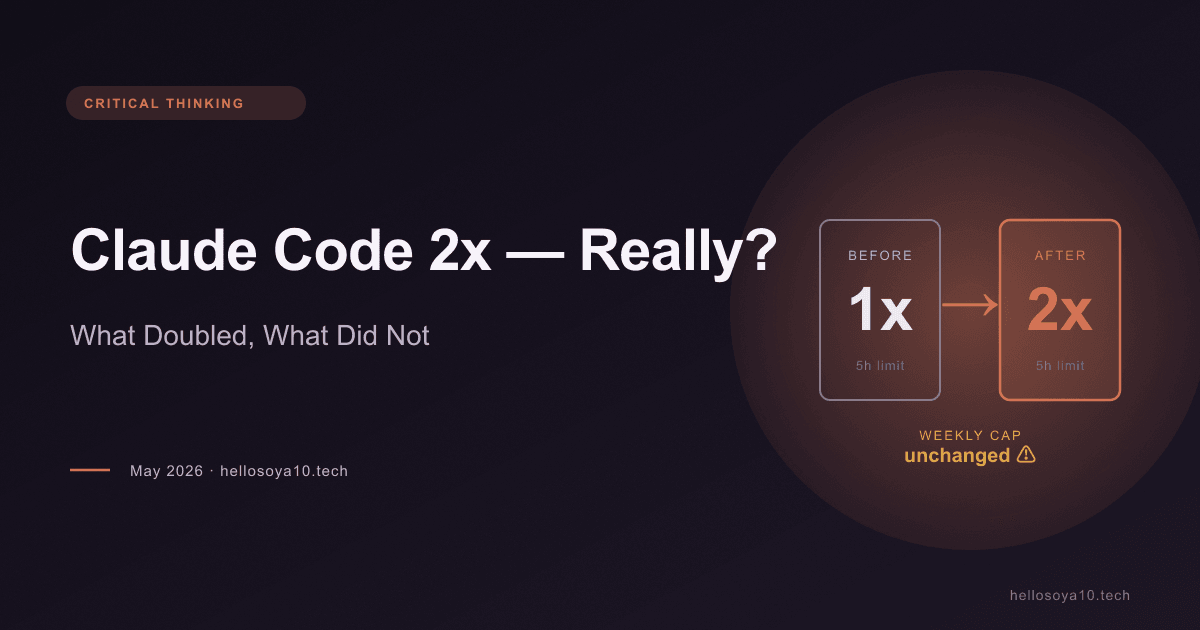
Bottom line first. Anthropic doubled Claude Code’s five-hour rate limit on May 6, 2026, but only for paid plans, and the weekly cap did not move. The headline is correct. The interpretation that has spread through tech press and developer Slacks — that Claude Code is now twice as productive — is not. This is a deliberately slow read of a fast-moving announcement, focused on what actually changed, what did not, and how to plan your workflow around the new limits without burning through your weekly quota.
Primary keywords: Claude Code rate limits, Claude Code 2x, Anthropic announcement, Claude Code Pro Max, Claude API rate limits.
- What Anthropic Actually Announced
- What Doubled, What Did Not — A Question Decomposition
- A Comparison Table
- Faster Limits Do Not Mean Faster Work
- The Spigot and the Bucket
- What This Tells Us About Anthropic’s Strategy
- When the New Headroom Actually Matters
- Plan-by-Plan Practical Decision
- A Workflow That Survives the Doubling
- Honest Boundaries on What I Verified
- Related Reading
- FAQ
- Conclusion
What Anthropic Actually Announced
The announcement is titled “Higher Limits with SpaceX,” published on May 6, 2026 (Anthropic News). The framing pairs the Claude Code rate limit increase with a new infrastructure deal: Anthropic gained access to SpaceX’s Colossus 1 datacenter, which provides over 300 megawatts of capacity and more than 220,000 NVIDIA GPUs. The infrastructure expansion is the why; the rate limit increase is the customer-facing what.
Three changes were announced on the same day. First, the five-hour rate limit for Claude Code was doubled, for Pro, Max, Team, and seat-based Enterprise plans. Second, Pro and Max users had their peak-hours throttling removed entirely. Third, on the Claude API side, Tier 1 customers received a 1500 percent increase in input tokens per minute and a 900 percent increase in output tokens per minute (Claude API Rate Limits).
What Anthropic did not publish is equally important. There is no before-and-after comparison table. The specific numerical limits — how many messages, how many tokens per session, how the weekly cap is calibrated — are not exposed in the announcement or in the support documentation. The change is described qualitatively. If you want to know what the new limits actually are, you discover them by hitting them.
For a critical read, that absence matters. A doubling claim with no baseline number is closer to marketing copy than measurement. The change is real, but third parties cannot verify the size of the change against any concrete metric. This is not a scandal — Anthropic has never published these numbers publicly — but it is the first thing to hold in mind when you read the headline.
What Doubled, What Did Not — A Question Decomposition
The right question is not “did rate limits double” but “what specifically doubled, and what did not.” Almost every misunderstanding around this announcement comes from collapsing those two questions into one.
| Question | Answer | Source |
|---|---|---|
| Did Claude Code’s 5-hour limit double? | Yes, for Pro / Max / Team / Enterprise | Anthropic News |
| Does the Free plan benefit? | No | Claude Support |
| Did API rate limits double too? | Separate change, Tier 1 input +1500%, output +900% | API Rate Limits |
| Did the weekly cap double? | No, unchanged | Inferred from omission in announcement |
| Can you do 2x more work per week? | Within a 5-hour window yes; per week no | Same |
| Did Opus consumption rate change? | No | Same |
The single most important entry in this table is the unchanged weekly cap. The announcement does not explicitly say the weekly cap was held constant — it just does not mention any change to it. Developer commentary across community blogs (claudefa.st) and tech press (XDA-Developers) reads the silence the same way: the spigot got wider, but the bucket stayed the same size.
A Comparison Table
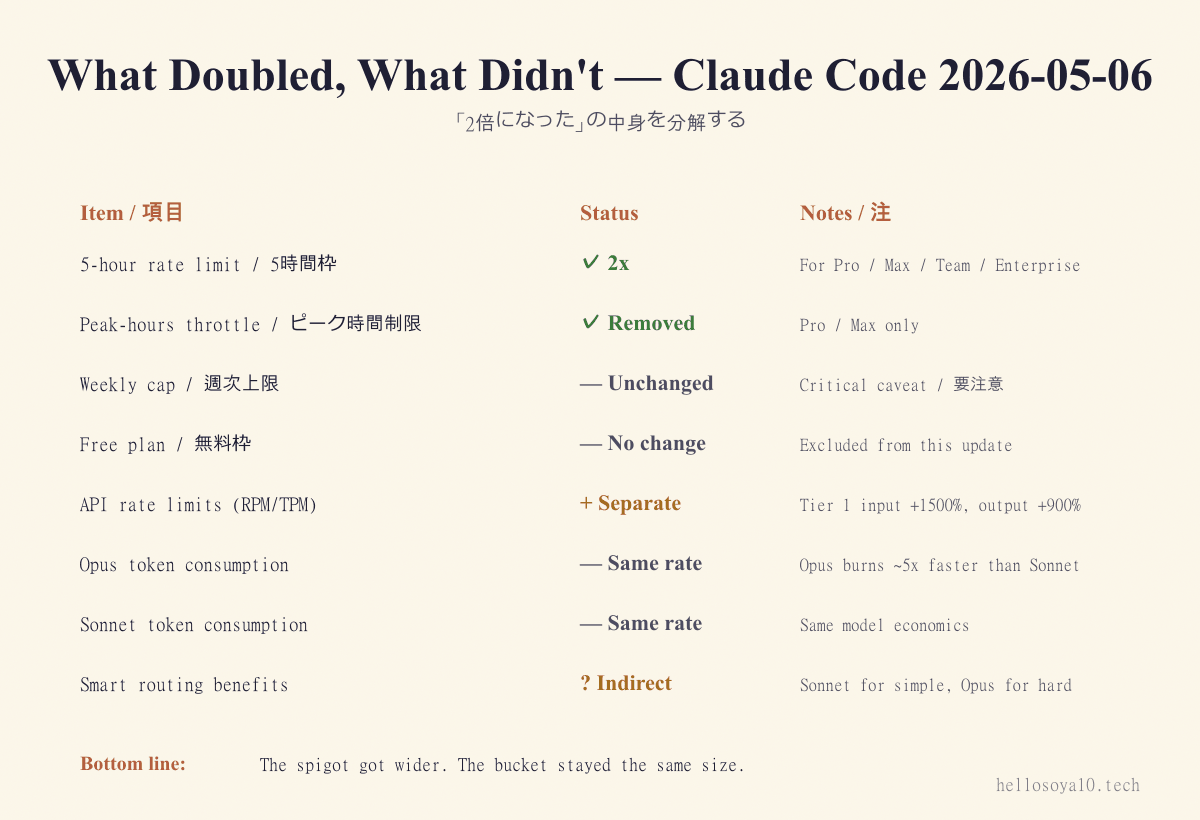
Here is the change set as a single view.
| Surface | Before | After | Caveat |
|---|---|---|---|
| Claude Code 5-hour limit | Baseline | 2x for Pro / Max / Team / Enterprise | Numerical baseline not published |
| Peak-hours throttling | Active during congestion | Removed for Pro / Max | Team / Enterprise unspecified |
| Weekly cap | Plan-specific | Unchanged | The bucket did not grow |
| Free plan | Limited | Unchanged | Excluded from update |
| API Tier 1 | Lower TPM | Input +1500%, output +900% | Separate from Claude Code quotas |
| Opus consumption | ~5x Sonnet’s rate | Unchanged | Heavy Opus burns the new quota fast |
| Sonnet consumption | Lighter | Unchanged | Smart routing remains valuable |
The clean takeaway is that the announcement is honest about what it is, but the marketing-grade summary that compresses it into “rate limits doubled” loses the parts that matter most for monthly planning.
Faster Limits Do Not Mean Faster Work
This is the philosophical claim worth planting. A doubled rate limit is the removal of a constraint. It is not, by itself, a productivity gain.
What turns a removed constraint into a productivity gain is the discipline you bring to using the new headroom. Claude Code, like every coding agent, will happily use whatever quota you give it. Vague prompts produce wide explorations. The agent reads more files than it needs to, proposes refactors you did not ask for, and burns tokens on speculative changes that you then have to roll back. Before the doubling, that behavior cost you a wait. After the doubling, it costs you the same number of confused hours, just faster.
A concrete example. I had a refactor I had been postponing — a configuration object that had grown to twelve fields and was being threaded through eight call sites. Pre-doubling, my pattern was to start the refactor, hit the five-hour cap somewhere in the middle of the third call site, and resume the next morning with cold context. Post-doubling, I sat down on Wednesday afternoon and finished the entire refactor in one session, including writing tests and verifying nothing downstream broke. That session was the clearest productivity win I have had in months. But the win came from the task being decomposed cleanly in advance — every call site change was isolatable, the tests were well-defined, the model was operating against a tight spec. None of that came from the rate limit doubling. The doubling let me do all of it inside one continuous attention window.
The opposite experience, also from the same week. I gave Claude Code an open-ended task: improve test coverage for a module. With the doubled quota, I let it run for a full session. By the end, I had thirty new test files, half of which tested behavior I would never test (deeply internal helpers nobody calls directly). Pre-doubling, the cap would have stopped me halfway through and forced me to look at what had been generated, which would have ended the session at a cleaner cut-off. The wider quota let me produce more low-quality output without the friction that used to interrupt me. Both sessions were enabled by the same change. Both were faster. Only one was better.
The Spigot and the Bucket
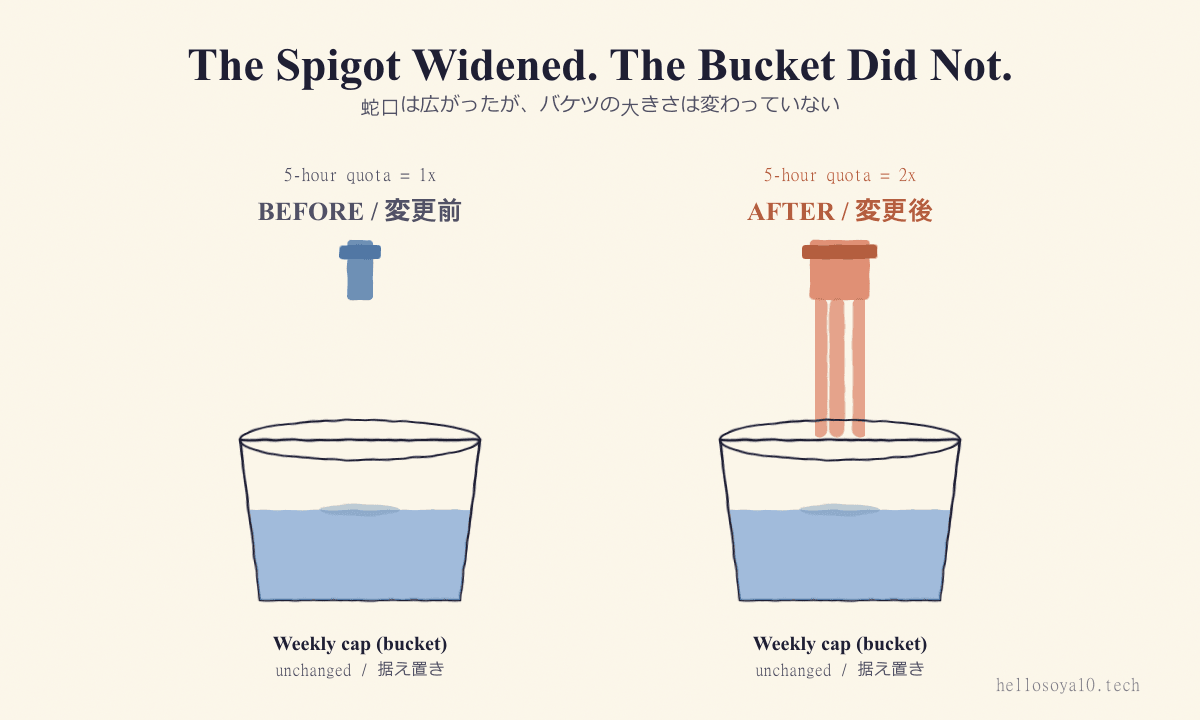
The mental model that has spread fastest in the developer community is the right one. The five-hour limit is the width of a spigot. The weekly cap is the size of a bucket. The May 6 change widened the spigot to twice its previous width. The bucket did not grow.
Per session, Claude Code now flows faster. Per week, you cannot draw more total water. If you used to hit the five-hour limit once a day, you now have headroom. If you used to brush against the weekly limit at the end of the week, you will hit it sooner, not later — because the wider spigot drains the bucket faster.
This is the constraint to plan around. Heavy users who let sessions sprawl will hit the weekly cap on Wednesday instead of Friday. Disciplined users who keep sessions tight will see the five-hour win as pure upside. The change rewards the prepared and amplifies the cost of unpreparedness.
What This Tells Us About Anthropic’s Strategy
Reading three changes together — Claude Code five-hour doubled, Pro and Max peak hours removed, API Tier 1 input plus 1500 percent and output plus 900 percent — produces a clearer picture than reading any one of them alone. The pattern is unambiguous: Anthropic is repositioning Claude Code as a product worth optimizing the user experience for, not as a feature attached to Claude.
The SpaceX datacenter framing is supporting evidence. Anthropic does not announce infrastructure deals to discuss megawatts. It announces them when there is a customer-facing constraint that the infrastructure relieves. The constraint, before May 6, was capacity at peak hours, at the edges of the five-hour window, and at API tier ceilings. That all three of those constraints relaxed on the same day suggests Anthropic decided developer workloads are now a strategic priority worth investing capital in.
This is a reading, not a confirmation. Anthropic did not announce a strategy shift. The strategy is inferred from the move. But for a developer deciding whether to invest in Claude Code-centric workflows, the inference matters: the company is signaling that Claude Code is a product they intend to keep widening, not a side project that competes with Claude.app for resources.
When the New Headroom Actually Matters
Not every workflow benefits equally from the doubling. A rough taxonomy.
Refactors of medium scope — five to fifteen files, well-understood transformation, mechanically applied — benefit substantially. These are sessions where pre-doubling you would hit the cap halfway through and lose context. The doubling lets the entire refactor live inside one cognitive window, which matters more than raw token throughput.
Tight, scoped feature work — implement function X, fix bug Y, add test Z — benefits negligibly. These sessions never approached the cap before, so doubling has no effect. The work is gated by task framing, not quota.
Exploratory debugging — root-causing flaky tests, tracking memory leaks, untangling unfamiliar codebases — benefits ambiguously. The agent can spend more time looking at related code, but more lookup time without tighter prompting means more tangential reading and longer paths to the actual cause. Whether the doubling helps or hurts depends almost entirely on prompt discipline.
Bulk code generation — scaffolding CRUD apps, generating boilerplate, producing test suites from scratch — benefits if and only if the spec is clean. With a clean spec, the doubling lets you generate twice as much per session. Without one, you generate twice as much output that does not match what you wanted, then spend the saved time editing it back.
The pattern across all four cases is the same. The doubling rewards prepared work and amplifies the cost of unprepared work. It does not change the underlying quality dynamics of the agent.
Plan-by-Plan Practical Decision
A short note on which plan makes sense after the change.
Free remains a trial tier. It is fine for evaluating Claude Code, but it does not benefit from the rate limit increase, and the gap to Pro just widened. If you are seriously evaluating Claude Code, paying for one month of Pro produces a more honest signal than running on Free.
Pro is the right default for individual developers. The doubled five-hour cap and removed peak-hours throttling are concentrated here. If you use Claude Code daily, Pro is the price-to-value sweet spot.
Max is for power users who routinely brushed against limits before. The doubling does not eliminate the weekly ceiling, but it pushes back the daily friction enough that Max becomes harder to justify as a default upgrade. The decision now hinges more on whether you genuinely need higher absolute limits than on whether the friction at Pro feels intolerable.
Team is the right tier for small companies where multiple developers share Claude Code workflows. The seat-based model and the doubled limits combine to make Team’s per-seat economics more favorable than they were last week.
Enterprise is governed by negotiation more than by the announcement. The seat-based Enterprise tier is included in the change; custom contract Enterprise terms are negotiated separately. If your company is on a custom contract, ask your account manager what specifically changed for you.
A Workflow That Survives the Doubling
The wider quota does not change the work that mattered before — it just makes it cheaper to skip. Here is the workflow I run.
First, I write the spec in Claude.app, not in Claude Code. One page: inputs, outputs, edge cases, tests. If I cannot write the spec, I am not ready to start. This step is unchanged by the rate limit increase, and it is still the highest-leverage activity in the loop.
Second, I decompose into tasks. One task is one to three files of changes. Larger tasks tempt the agent to range broadly and produce sprawling diffs. The doubling makes large tasks more feasible to attempt; smaller tasks remain higher quality.
Third, I send one task at a time to Claude Code with a tight prompt. Here is a template I use:
You are a development agent that modifies an existing codebase without breaking it.
First, investigate related files and present a short change plan.
Do not refactor outside the scope of this task.
The goal is X.
The change should be limited to file(s) Y.
After implementing, summarize the change, the test plan, and any concerns.
Fourth, I read the diff. Every session. The wider spigot makes the diff larger; reading it is cheaper than fixing the wrong merge later.
Fifth, I run the tests. The agent will write tests if asked; the human’s job is to verify they test what they claim to test, not just that they pass.
Sixth, if anything fails, I send a small follow-up — “this test failed, here is the output, propose the cause and fix” — rather than re-running the original prompt.
Seventh, I review for design consistency before merging. The agent does not understand the team’s conventions. That is human work.
This loop predates the doubling and does not change after the doubling. What changes is that more of the loop fits inside one human attention window, which matters for cognitive coherence even though it does not change the per-step quality.
Honest Boundaries on What I Verified
Worth flagging the boundaries of confidence in this article.
What I can verify directly from Anthropic: the date (May 6, 2026), the scope (Pro / Max / Team / seat-based Enterprise), the three specific changes, and the exclusion of Free plan from the update. These are sourced from the official news post and Anthropic support documentation.
What I am inferring rather than verifying: the strategic reading that Anthropic is repositioning Claude Code as a flagship product. This is supported by the simultaneity of the changes and the framing of the announcement, but Anthropic did not state it.
What I am observing rather than measuring: the workflow effects. My example sessions are subjective accounts from a single user over a few days. They are honest accounts but they are not measurements.
What is unconfirmed in the broader discussion: the specific numerical baselines. Anthropic has not published “X messages per five hours, before; 2X messages per five hours, after.” Community estimates exist but they are inferred from observed throttling, not from official documentation. Treat any specific number you see for the new limits as an estimate unless it is sourced directly to Anthropic.
Related Reading
Before deciding to invest in Claude Code-centric workflows, it is worth comparing alternatives and understanding the broader AI development tool landscape. The Claude Code vs Cursor 2026 comparison covers when each tool earns its place. The Opus 4.7 review covers the underlying model’s cost and performance profile. For a low-budget setup, the $20 AI stack guide shows how to combine multiple AI tools without exceeding a tight monthly budget. For GPT-5.5 prompt design as a counterpoint, the Codex GPT-5.5 practical guide covers similar workflow questions on the OpenAI side.
FAQ
Q. Did Claude Code’s rate limits actually double?
Yes, but only the five-hour rate limit, and only for Pro, Max, Team, and seat-based Enterprise plans (Anthropic News). The Free plan was not affected, the weekly cap did not change, and Claude API rate limits are tracked separately.
Q. Does the Free plan benefit from this update?
No. The Free plan is excluded from the rate limit doubling. To benefit from the update, you need a Pro subscription or higher (Claude Support).
Q. Did the peak-hours throttling really get removed?
For Pro and Max, yes. The official announcement specifically calls out the removal of peak-hours throttling for those tiers. Team and Enterprise behavior was not detailed in the same way; the working assumption is that seat-based plans inherit similar treatment, but readers on Team or Enterprise should verify with Anthropic support.
Q. Did the weekly cap also double?
No. Anthropic did not announce a change to the weekly cap, and the omission is consistent across the public-facing materials. This is the most important caveat for power users: the spigot widened, the bucket did not. Heavy daily use will hit the weekly ceiling earlier than before.
Q. Are Claude Code limits and Claude API rate limits the same thing?
No, they are tracked separately (Claude API Rate Limits). The Claude Code five-hour quota governs subscription usage through the Claude Code product. The Claude API uses a tier-based RPM and TPM model. Both expanded on May 6, 2026, but they are independent surfaces.
Q. Does using Opus burn the new quota faster?
Yes. Opus consumes tokens at roughly five times the rate of Sonnet for equivalent work, and the May 6 update did not change per-model consumption rates. Heavy Opus use will not feel like a clean two-times improvement even within the doubled five-hour window. Smart routing — Sonnet for straightforward tasks, Opus only when reasoning genuinely requires it — recovers a meaningful fraction of the new headroom.
Conclusion
The May 6, 2026 update is real, narrow, and significant for paid plans. It is not the same thing as a doubled total quota, a doubled productivity ceiling, or a free upgrade for everyone using the product.
The right way to read the announcement is as a signal: Anthropic is investing in Claude Code as a strategic product, capacity constraints are easing, and developer workloads are getting more serious infrastructure attention. The right way to use the announcement is to keep your workflow disciplined, default to Sonnet when you can, watch the weekly cap, and treat the new five-hour headroom as a chance to run more iterations of small tasks rather than fewer iterations of big ones.
The spigot widened. The bucket did not. Plan accordingly.
——
🌱 Newsletter: Practical AI development tool reviews, cost optimization, and workflow design — delivered weekly. Subscribe here.
📬 Sponsorship / Inquiries: AI product reviews, media production, and consulting. Contact form.
📚 Recommended next reads: Claude Code vs Cursor 2026 / Opus 4.7 review / $20 AI stack / Codex GPT-5.5 practical guide

コメント