Context Engineering: The 2026 Skill That’s Quietly Replacing Prompt Engineering
By S | AI Director & Freelance Creator, rural Japan
Hello, this is S.
Prompt engineering had a good run. The idea was compelling: if you phrased your instructions to an AI model in precisely the right way, you’d unlock dramatically better outputs. Whole courses, certifications, and job titles emerged around this skill.
In 2026, something more important has replaced it. It’s called context engineering — and if you’re working with AI tools seriously, you’re already doing it, whether or not you have a name for it.
What Prompt Engineering Actually Was
Prompt engineering was fundamentally about what you say to a model in a single turn. Chain-of-thought prompting, few-shot examples, role assignment (“you are an expert in…”), output format specification — these are all techniques for shaping a single request.
For simple, self-contained tasks, these techniques remain useful. Asking an AI to summarize a document, write a function, or translate a paragraph benefits from clear, well-structured prompts.
But most real work isn’t simple or self-contained. It’s distributed across files, sessions, tools, and time. And for that kind of work, prompt engineering is the wrong unit of analysis.
What Context Engineering Is
Context engineering is the practice of managing what information is present in a model’s working memory at the moment it needs to produce output.
This includes:
What you include — the files, documents, code, and history you pass into the context window. Not everything; the right things. A context window full of irrelevant data produces worse outputs than a carefully curated one.
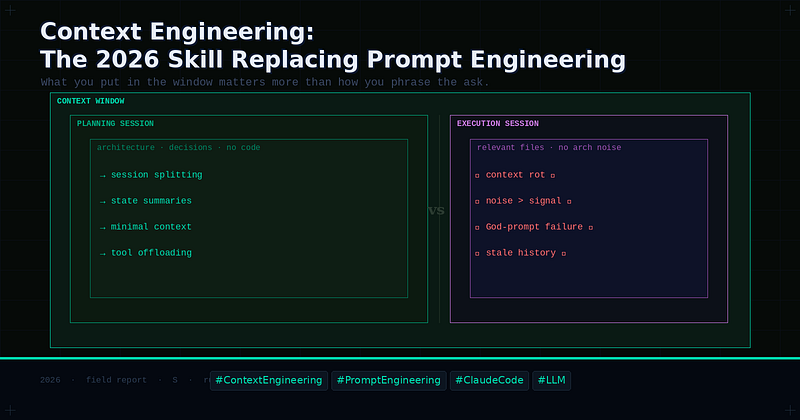
What you exclude — equally important. Irrelevant context creates noise that degrades signal. Engineers working with Claude Code have named this “context rot”: the gradual degradation in output quality as a context window accumulates stale, contradictory, or tangential information.
How you structure the session — breaking a large task into phases, each with a clean context tailored to that phase. A planning phase, an execution phase, a review phase — each with different context loaded.
When you reset — knowing when the accumulated context is hurting more than helping, and starting a fresh session with a precisely scoped brief.
Why This Matters More Than Prompt Technique
The shift from prompt engineering to context engineering reflects a deeper change in how AI is actually used.
In 2023, most AI usage was single-turn: ask a question, get an answer, done. In that world, prompt technique was the primary lever.
In 2026, most serious AI usage is multi-turn, multi-file, and multi-session. You’re running agents across a codebase, iterating on a document over days, or orchestrating a workflow that spans multiple tools. In that world, the quality of your prompt matters far less than the quality of your context management.
A mediocre prompt in a well-structured context produces good output. A brilliant prompt in a polluted context produces garbage.
Practical Techniques
Session splitting by phase. When I’m building a new feature with Claude Code, I run a separate session for planning (architecture discussion, no code) and a separate session for implementation (relevant code files loaded, no architecture noise). Mixing these creates context rot.
Explicit state summaries. At the end of a long session, I ask the model to produce a brief summary of decisions made and current state. This summary becomes the opening context for the next session — much cleaner than carrying forward the full conversation history.
Minimal context per task. For a specific debugging task, I load only the files directly relevant to the bug. Not the whole codebase. Not the tests. Just the files. The precision of the output correlates directly with the precision of the context.
Offloading to tools. Context engineering isn’t just about what you put in the window — it’s about what you keep out by externalizing to tools. Instead of pasting a CSV into the context and asking the model to analyze it line by line, you have the model write a Python script that processes it. The data stays out of the context; only the logic enters.
The Zettelkasten Connection
If you’ve spent time with personal knowledge management systems — Obsidian, Zettelkasten, roam-style tools — context engineering will feel familiar. The underlying skill is the same: deciding what information belongs in active working memory versus long-term storage, and designing the retrieval mechanism that brings the right information to the surface at the right moment.
The difference is that in Zettelkasten, the working memory is your own cognition. In context engineering, the working memory is the model’s context window. The management principles transfer almost directly.
What to Actually Practice
Context engineering is a practical skill, which means it improves through deliberate iteration rather than study.
Start by auditing your last five AI sessions. For each one, ask: what was in the context that didn’t need to be there? What was missing that would have helped? How did the context evolve over the session, and at what point did output quality start to degrade?
That audit will teach you more than any framework. The patterns you find will be specific to your workflow and your tools — which is exactly why context engineering is hard to reduce to a course or a certification.
It’s a judgment skill, not a rule-following skill. That’s what makes it durable.
I write weekly on practical AI tool usage for solo developers and content creators. If your company builds AI tools and wants to reach this audience, I’m open to sponsorship conversations: johnpascualkumar077.github.io/portfolio/
— –
If this was useful, follow me here on Medium.
I’m S — a content creator and AI practitioner based in rural Japan (Shimane Prefecture). I publish practical, honest takes on AI tools, content monetization, and what it actually looks like to build income with these tools from outside a major city.
[Follow →](https://medium.com/@johnpascualkumar077)
Tags: Context Engineering Prompt Engineering AI Tools Claude Code Developer Productivity LLM 2026

コメント