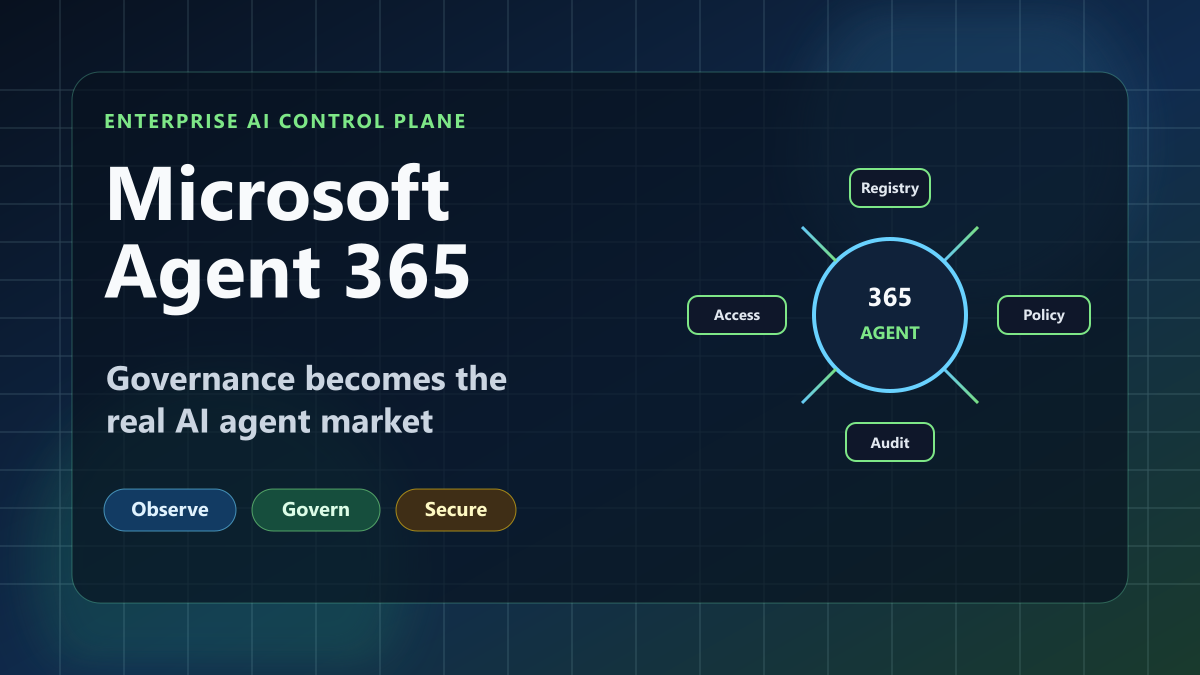
As of May 1, 2026, Microsoft Agent 365 is no longer just a future-facing enterprise AI idea. Microsoft says Agent 365 is generally available on May 1 at $15 per user, and the broader Microsoft 365 E7 Frontier Suite is also generally available on May 1 at $99 per user.
That matters because the AI agent market is moving past the easy demo phase.
The first wave was about building agents. The next wave is about controlling them. Once a company has agents reading documents, creating tickets, answering customers, touching data, and coordinating with other agents, the hard question is no longer "Can we build one?" It is "Can we see, govern, secure, and retire all of them before they become operational risk?"
That is the market Microsoft Agent 365 is trying to own.
- The 30-Second Answer
- Confirmed Facts
- Why Agent Governance Became the Real Problem
- What Agent 365 Actually Changes
- Why Microsoft Is Pushing This Now
- The Reader Problem: "We Have Agents, But No Operating Model"
- Practical Use Cases
- Risks and Limits
- A Practical Rollout Checklist
- How This Connects to MCP and Prompting
- Who Should Pay Attention
- My Take
- Need Help Turning AI Agents Into a Real Workflow?
- Sources
The 30-Second Answer
Microsoft Agent 365 is a control plane for enterprise AI agents.
It is not just another chatbot builder. Microsoft positions it as the layer IT and security teams can use to observe, govern, manage, and secure agents across the organization, including agents built on Microsoft platforms and third-party environments.
The practical takeaway:
- If your company has a few experimental agents, Agent 365 is probably a governance conversation.
- If your company has dozens of agents across departments, it becomes an inventory and risk conversation.
- If your company already lets agents access business systems, customer data, or internal knowledge, it becomes a security conversation.
The business value is simple: the more useful agents become, the more dangerous unmanaged agent sprawl becomes.
Confirmed Facts
Here is what Microsoft has officially announced:
| Item | Confirmed Detail |
|---|---|
| Product | Microsoft Agent 365 |
| Availability | General availability on May 1, 2026 |
| Price | $15 per user, according to Microsoft's March 9 announcement |
| Suite packaging | Included in Microsoft 365 E7: The Frontier Suite |
| E7 price | $99 per user, according to Microsoft's March 9 announcement |
| Core role | Observe, govern, manage, and secure AI agents |
| Related builder | Microsoft Copilot Studio |
| Related platform shift | Microsoft 365 Copilot Wave 3 and multi-agent orchestration |
Microsoft also said more than 90% of the Fortune 500 now use Microsoft 365 Copilot, and its April 28 business update frames Agent 365 as the trust layer beside Microsoft IQ as the intelligence layer.
The signal is obvious: Microsoft is not treating agents as a side feature. It is turning agents into an enterprise management category.
Why Agent Governance Became the Real Problem
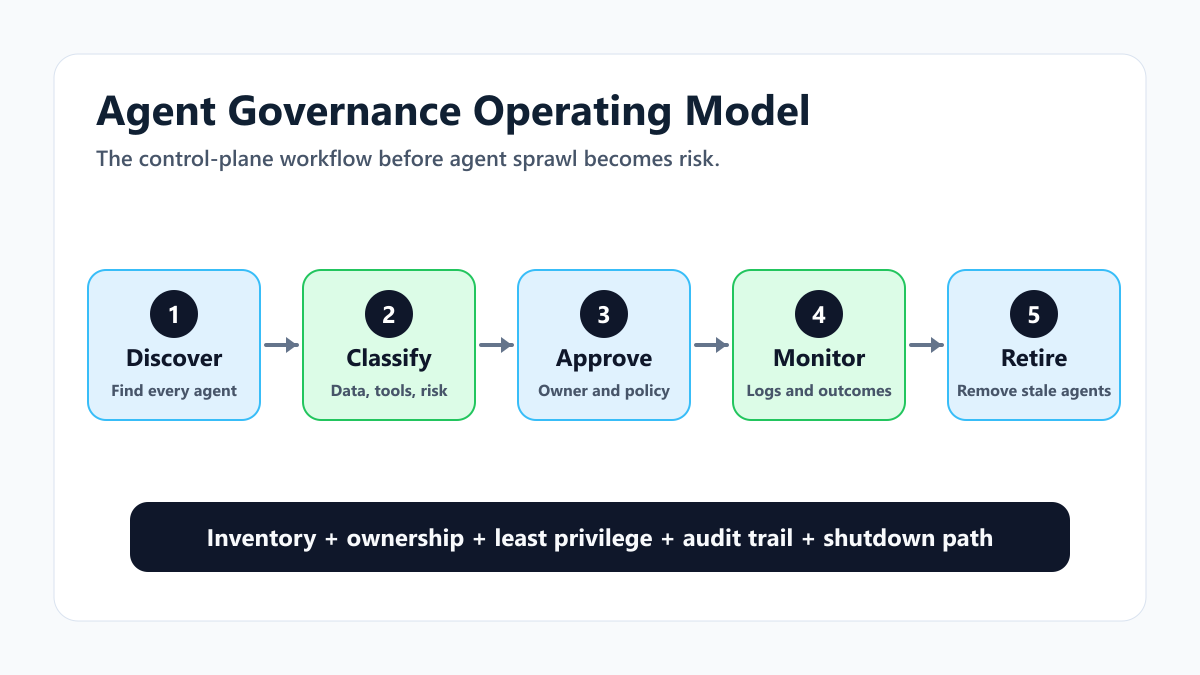
Every useful agent creates a management problem.
A simple drafting assistant may only need prompt quality and user training. But an operational agent needs much more:
- What data can it read?
- What tools can it call?
- Which identity does it act under?
- Who approved it?
- What logs prove what it did?
- Can it be paused immediately?
- Can security see every agent that exists?
- Can the business measure whether it is worth keeping?
This is where most AI programs get messy. Teams build agents because the tooling is accessible. Marketing builds a campaign agent. Support builds a triage agent. Finance builds a reporting agent. Engineering builds a code review agent. Suddenly, nobody has one clean view of the system.
That is agent sprawl.
Microsoft's own March 9 announcement says the company has visibility into more than 500,000 internal agents and that tens of millions of agents appeared in the Agent 365 Registry during preview. Even if those numbers are Microsoft-specific, they illustrate the shape of the problem: once agent creation becomes easy, governance becomes the bottleneck.
What Agent 365 Actually Changes
The most useful way to understand Agent 365 is to separate three layers:
- Agent builders create the agent.
- Business apps give the agent work context.
- A control plane manages the agent estate.
Copilot Studio sits mainly in the first layer. Microsoft 365 Copilot and Microsoft IQ sit closer to the work-context layer. Agent 365 is Microsoft trying to own the third layer.
That third layer matters because a real company cannot run on vibes. It needs:
- Registry: a reliable inventory of agents.
- Access control: who can create, use, or modify agents.
- Observability: logs, usage, errors, and outcomes.
- Governance: review paths, policies, ownership, and lifecycle rules.
- Security: detection of risky behavior and enforcement of enterprise protections.
- Interoperability: a way to manage agents that do not all live in one isolated product.
This is why Agent 365 is strategically more important than it looks. The product is not competing only with chat apps. It is competing for the management layer of agentic work.
Why Microsoft Is Pushing This Now
The timing makes sense.
Microsoft's April Copilot Studio update says multi-agent systems are now generally available across several capabilities, including Microsoft Fabric integration, Microsoft 365 Agents SDK orchestration, and Agent-to-Agent communication support. That means enterprise agents are becoming less isolated and more coordinated.
Coordination increases value. It also increases blast radius.
A single agent that answers FAQs is easy to supervise. A network of agents that delegates work across analytics, productivity apps, customer systems, and internal policies is harder. When an agent can hand work to another agent, the organization needs clearer answers about identity, permissions, audit trails, and accountability.
That is the practical reason Agent 365 matters now.
The Reader Problem: "We Have Agents, But No Operating Model"
Most companies do not fail at AI because nobody can build a demo.
They fail because the demo does not become a durable workflow.
The common failure pattern looks like this:
- A team builds a useful agent.
- Other teams copy the pattern.
- Each agent gets slightly different permissions and prompts.
- Nobody owns the whole inventory.
- Security asks what the agents can access.
- The business asks what ROI they deliver.
- Everyone realizes the agent program is bigger than the governance system around it.
Agent 365 is aimed directly at that gap.
If Microsoft succeeds, the buying question for large companies changes from "Which model is smartest?" to "Which platform lets us scale agents without losing control?"
That is a more valuable question.
Practical Use Cases
Here are the use cases where Agent 365 is easiest to justify.
1. Agent Inventory
If your company cannot list every production or semi-production agent, you cannot govern agents.
The first use case is not glamorous. It is inventory:
- Which agents exist?
- Who owns each one?
- Which systems do they touch?
- Which users rely on them?
- Which agents are inactive, duplicated, or risky?
This is the boring foundation that makes everything else possible.
2. Security Review
Agents that read sensitive data, trigger workflows, or call tools need policy review.
The review should focus on actions, not just prompts:
- Can the agent write to business systems?
- Can it send external messages?
- Can it access customer records?
- Can it create files or tickets?
- Can it delegate work to another agent?
The more side effects an agent has, the more governance it needs.
3. Multi-Agent Workflow Control
Multi-agent orchestration is powerful because specialist agents can cooperate. It is risky for the same reason.
A sales agent might ask a pricing agent for discount rules. A support agent might ask a knowledge agent for troubleshooting steps. A finance agent might ask an analytics agent for revenue data.
That can be useful. But every handoff needs traceability.
The governance question becomes: when the final answer is wrong, can you trace which agent supplied which part of the work?
4. ROI Measurement
Agent governance is not only a security topic.
It is also an investment topic.
If agents are everywhere, leaders need to know which ones create value. Usage counts alone are not enough. A good operating model connects agent activity to outcomes:
- Tickets resolved.
- Manual steps removed.
- Drafting time reduced.
- Errors prevented.
- Customer response speed improved.
- Revenue workflows accelerated.
Without measurement, agent programs become a pile of impressive anecdotes.
Risks and Limits
Agent 365 does not remove the need for engineering judgment.
The main risks are:
- Governance theater: buying a control plane without defining ownership and policy.
- Over-permissioned agents: letting agents access more data or tools than they need.
- Shadow agents: teams building outside approved platforms because official workflows are too slow.
- Audit gaps: logging that captures usage but not enough context to reconstruct decisions.
- Vendor concentration: adopting one control plane before understanding the full agent ecosystem.
The biggest trap is assuming a product name equals an operating model. It does not.
Agent 365 may give teams a better place to govern agents, but the company still needs rules.
A Practical Rollout Checklist
If I were advising an enterprise team this week, I would start here:
Week 1: Build the Agent Inventory
Create one list with:
- Agent name.
- Owner.
- Business function.
- Platform.
- Data sources.
- Tools and actions.
- User group.
- Production status.
- Risk level.
Do not wait for a perfect taxonomy. A rough inventory today beats a polished governance slide six weeks from now.
Week 2: Classify Agent Risk
Use four levels:
| Level | Description | Example |
|---|---|---|
| Low | Reads public or low-risk data only | Internal FAQ helper |
| Medium | Reads internal data but has no write actions | Policy search agent |
| High | Writes to systems or sends messages | Ticket triage agent |
| Critical | Touches customer data, financial workflows, security workflows, or external actions | Refund, HR, or incident response agent |
Governance should scale with risk.
Week 3: Define Approval Rules
Every production agent needs:
- One human owner.
- One fallback owner.
- A review date.
- Documented data access.
- Documented tool access.
- A rollback or shutdown path.
- A short description of expected business value.
This is not bureaucracy. It is how you avoid mystery automation.
Week 4: Add Monitoring and Retirement
Most teams remember launch and forget retirement.
Set rules for:
- Usage thresholds.
- Error thresholds.
- Permission drift.
- Prompt or tool changes.
- Inactive agents.
- Duplicate agents.
- Agent retirement.
The agent you forget about is the agent that becomes expensive or risky later.
How This Connects to MCP and Prompting
Agent governance does not live in one product.
If your agents use external tools or protocols, the same risk pattern appears. In my MCP production security guide, the key point is that interoperability does not equal trust. That logic applies here too.
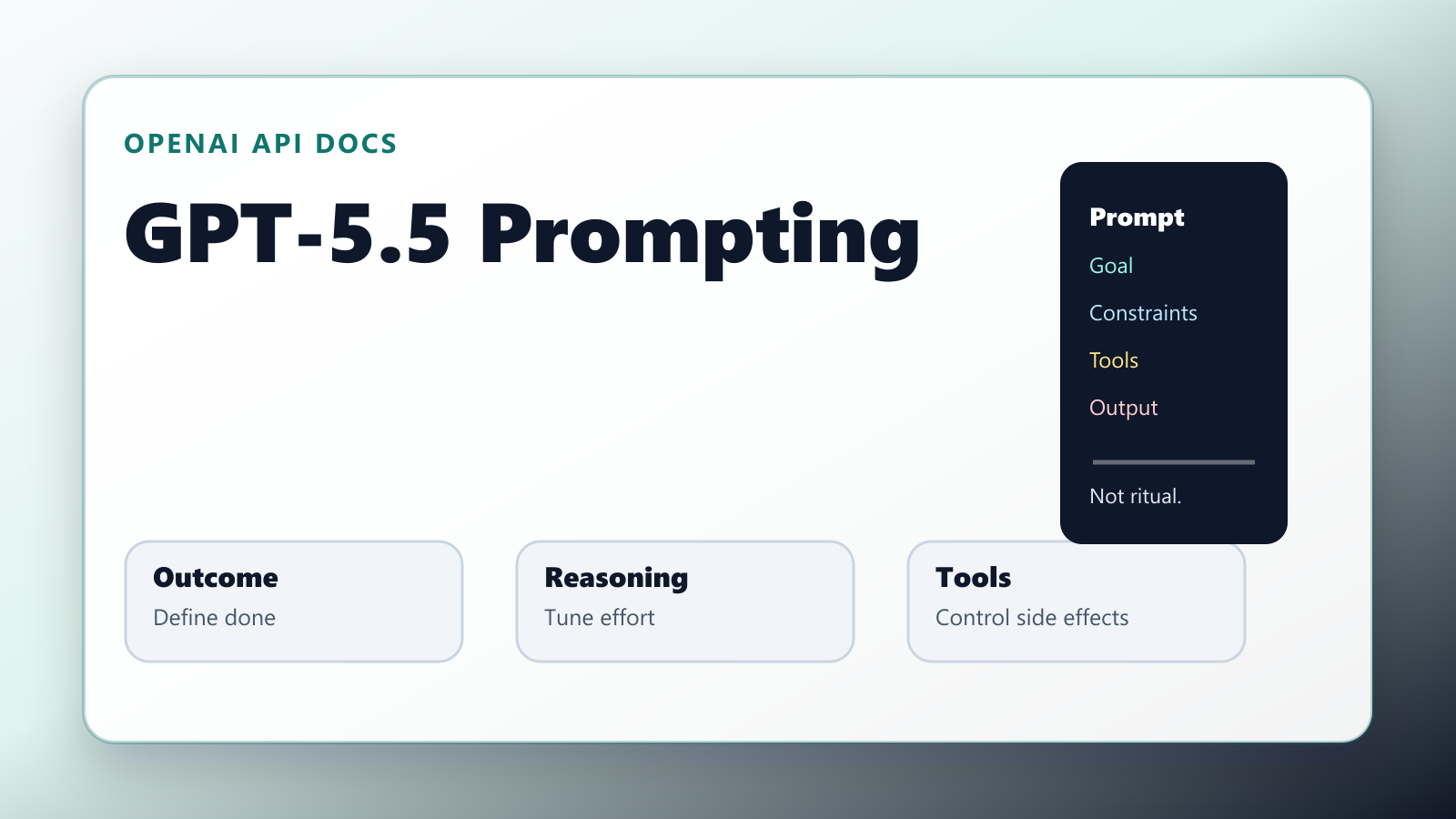
If your agents depend on prompt contracts, tool use, and structured output, you also need cleaner prompting standards. The GPT-5.5 prompting guide explains why modern prompts should define outcome, constraints, evidence, tools, and verification instead of bloated step-by-step rituals.
Agent 365 is the platform-level version of the same idea: define what exists, what it can do, who owns it, and how you know it worked.
Who Should Pay Attention
Microsoft Agent 365 is especially relevant for:
- CIOs and CTOs who need visibility into AI adoption.
- CISOs who need agent security and auditability.
- IT admins managing Microsoft 365 and Copilot environments.
- AI program leads moving from pilots to production.
- Consultants building enterprise AI operating models.
- Product teams embedding agents into business workflows.
It is less urgent for solo creators, small teams with one or two lightweight automations, or teams that have not yet connected agents to meaningful business systems.
But if you are already building internal agents, this category is coming for you.
My Take
Microsoft Agent 365 is important because it names the problem everyone serious about AI agents is about to have.
Building agents is getting easier. Trusting, governing, measuring, and retiring them is not.
That is why the control plane may become more commercially important than the individual agent builder. Builders create adoption. Control planes protect scale.
The practical move is not to wait until agent sprawl is painful. Start with inventory, ownership, permissions, and logging now. If you later adopt Agent 365, you will already know what to plug into it.
Need Help Turning AI Agents Into a Real Workflow?
I help teams turn scattered AI experiments into practical, governed workflows: article pipelines, research agents, prompt systems, and WordPress automation that can actually ship.
Start here:
コメント