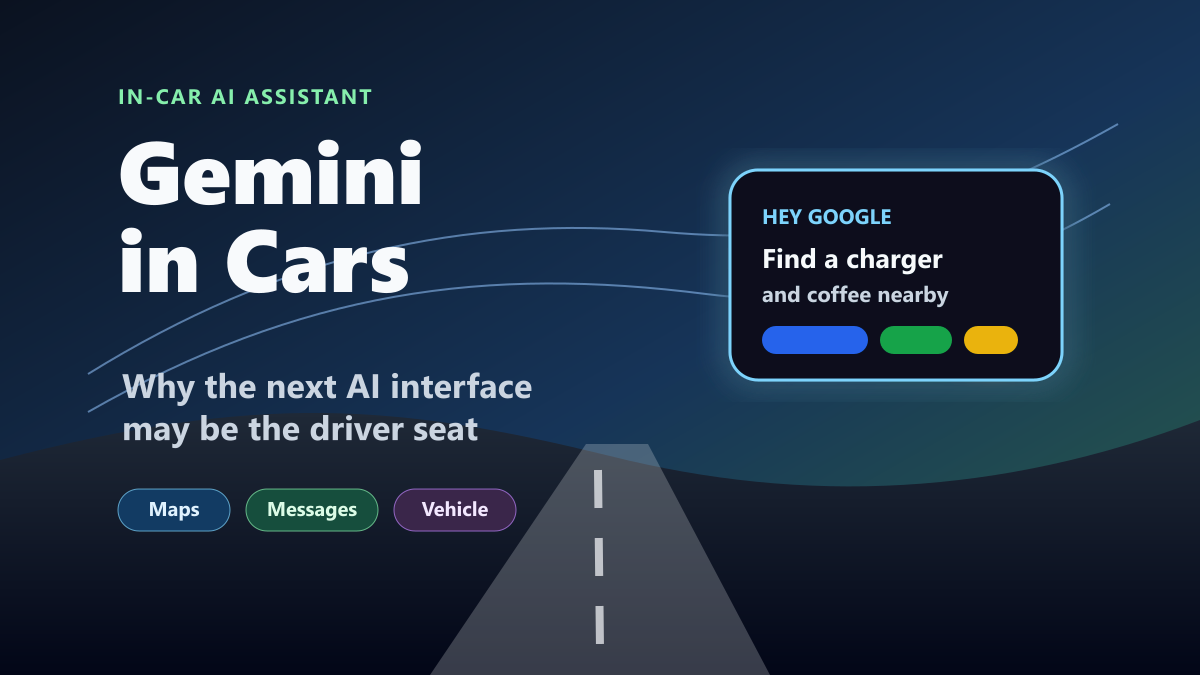
Google says Gemini is starting to roll out in cars with Google built-in as an upgrade from Google Assistant. GM says eligible model year 2022 and newer Cadillac, Chevrolet, Buick, and GMC vehicles in the U.S. with Google built-in will get Gemini soon, with approximately 4 million GM vehicles eligible for the update.
This is not just another AI feature announcement.
The car may become one of the most important real-world AI interfaces because it combines three things most chatbots do not have at the same time: voice-first interaction, physical context, and immediate utility.
When you are driving, you cannot comfortably type a perfect prompt. You need the assistant to understand messy intent, handle follow-up questions, use live context, and complete small tasks without pulling your attention away from the road.
That is exactly the problem Gemini in cars is trying to solve.
- The 30-Second Answer
- Confirmed Facts
- Why the Car Is a Better AI Interface Than It Looks
- What Gemini Changes Compared With Old Voice Assistants
- The GM Rollout Is the Strategic Signal
- Practical Use Cases
- What Businesses Should Do
- Risks and Limits
- My Take
- How This Fits the Larger AI Shift
- Need Help Turning AI News Into Practical Content?
- Sources
The 30-Second Answer
Gemini in cars matters because it moves AI from the desk to the driver's seat.
Instead of asking users to learn rigid voice commands, Google says Gemini will let drivers speak naturally, ask follow-up questions, manage messages, find stops, control settings, learn about destinations, and get vehicle-specific information from manufacturer-provided owner's manuals.
GM's rollout gives the announcement immediate scale. The company says about 4 million eligible U.S. vehicles can receive the update across Cadillac, Chevrolet, Buick, and GMC vehicles with Google built-in.
The practical takeaway:
- For drivers, this could make voice assistants less annoying and more useful.
- For automakers, it turns the software layer into a customer experience differentiator.
- For Google, it puts Gemini inside a high-frequency, real-world environment.
- For businesses, it opens a new surface for local search, media, navigation, service, and vehicle support.
Confirmed Facts
Here is what is confirmed from official Google and GM sources:
| Item | Confirmed Detail |
|---|---|
| Product | Gemini in cars with Google built-in |
| Google announcement date | April 30, 2026 |
| GM announcement date | April 28, 2026 |
| First rollout language | English in the United States |
| Rollout method | Software update for new and existing cars with Google built-in |
| GM eligible vehicles | Model year 2022 and newer Cadillac, Chevrolet, Buick, and GMC vehicles with Google built-in |
| GM scale | Approximately 4 million eligible vehicles in the U.S. |
| Requirements listed by GM | OnStar connection, signed into Google Play Store, U.S. English assistant language, opt-in to Gemini |
| Expansion | More languages and countries are planned over time |
Google also says Gemini Live is in beta for cars, giving drivers a more free-flowing conversation mode.
Why the Car Is a Better AI Interface Than It Looks
Most AI products still assume the user has a screen, a keyboard, and time.
The car does not.
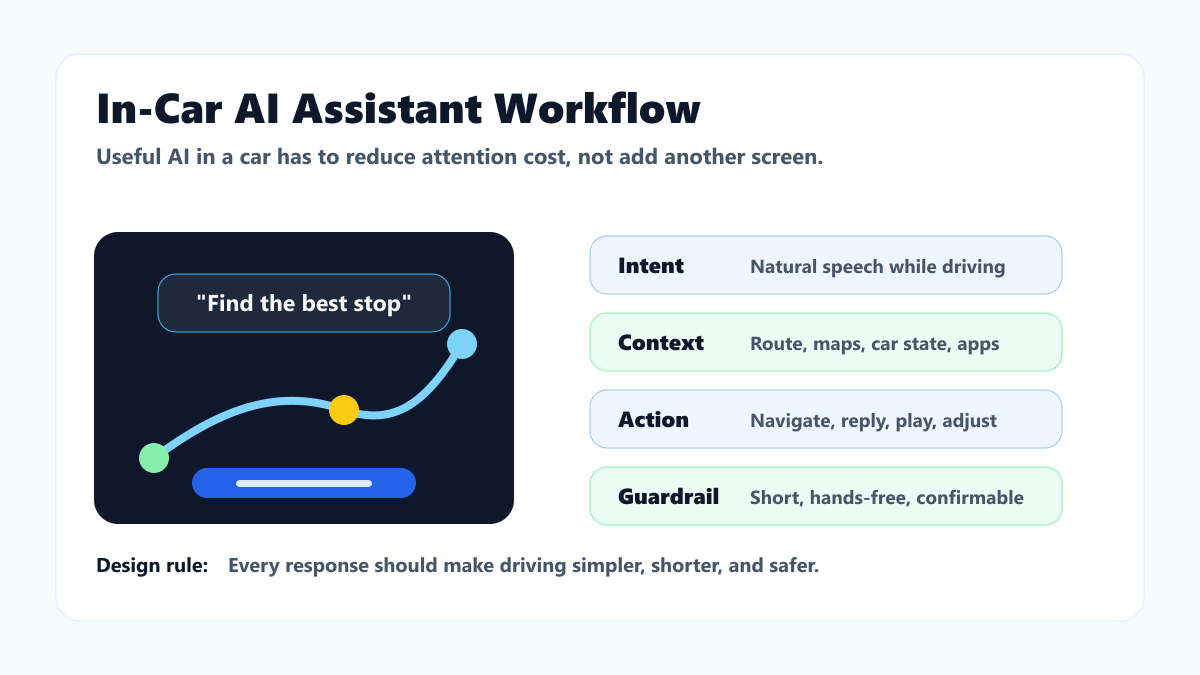
That constraint is exactly what makes the car interesting. A good in-car assistant cannot depend on long prompt writing or perfect menu navigation. It needs to infer intent from natural speech and keep the interaction short enough to preserve attention.
That pushes AI toward practical utility:
- Find a restaurant along the route.
- Summarize messages and help draft a reply.
- Adjust media to match the trip.
- Explain a dashboard feature.
- Find a charger and nearby cafe.
- Answer questions about the destination.
- Help plan several stops.
- Change a route after a follow-up question.
This is the kind of AI normal people can understand immediately.
No dashboard full of model settings. No prompt engineering ritual. Just "Hey Google" and a useful answer.
What Gemini Changes Compared With Old Voice Assistants
Old car voice assistants often failed for three reasons:
- They required exact commands.
- They forgot context quickly.
- They were disconnected from the real task.
Gemini is aimed at those weak points.
Google says drivers can have natural, hands-free conversations. In practice, that means the assistant should handle messy requests like:
- "I need lunch, but I want somewhere sit-down, highly rated, on the way, and not too far from the route."
- "Reply that I am on my way and include my ETA. Actually, ask if I should pick up dessert too."
- "It is foggy and freezing in here."
The important change is not that the assistant can answer trivia. The change is that it can maintain enough context to make follow-up requests feel normal.
That is the difference between command recognition and assistant behavior.
The GM Rollout Is the Strategic Signal
Google's announcement is important. GM's announcement is the scale signal.
GM says Gemini will roll out soon to eligible model year 2022 and newer Cadillac, Chevrolet, Buick, and GMC vehicles in the U.S. with Google built-in. The company says approximately 4 million vehicles are eligible.
That matters because AI products often struggle to cross from demo to distribution.
Automotive distribution is different. A software update can put the feature into vehicles people already own. The user does not need to buy a new AI gadget or install a new productivity app. The interface is already there: the car screen, the microphone, the steering wheel button, and the assistant wake phrase.
This is why in-car AI could matter more than many browser-based AI features. It reaches people during a real task, not during an artificial demo.
Practical Use Cases
The most useful Gemini-in-car use cases cluster around five jobs.
1. Route and Local Search
Drivers rarely ask clean search queries.
They ask messy, situational questions:
- "Find something quick but not fast food."
- "Find a coffee shop with outdoor seating."
- "Is there an event near that stadium?"
- "Find a charger nearby, and somewhere to wait while I charge."
Gemini can combine Maps context, route context, and conversational follow-up. For local businesses, this makes structured presence more important. If your hours, amenities, menu, reviews, and location data are weak, AI assistants have less reason to surface you.
2. Messaging Without Touching the Phone
GM says Gemini can summarize incoming messages and help drivers draft, edit, or translate responses without touching the phone.
This is a very practical use case because the car is one of the worst places to manage messages manually.
The risk is also obvious: the assistant must preserve attention and avoid turning the drive into a chat session. Good UX here means short, confirmable, low-friction interactions.
3. Entertainment and Trip Mood
GM lists music, podcasts, and streaming experiences as a major use case.
This is more important than it sounds. Media is one of the highest-frequency in-car behaviors. If Gemini can turn vague intent into a playlist, station, podcast, or show, it becomes part of daily habit formation.
The winning assistant is not the one with the most features. It is the one people use repeatedly without thinking.
4. Vehicle-Specific Help
Google says Gemini can answer questions using manufacturer-provided owner's manuals, with availability varying by brand and model.
This could be one of the most valuable use cases.
Owner's manuals are dense. Drivers often need help at the exact moment they do not want to search a PDF:
- How do I prepare for an automatic car wash?
- How do I set the trunk height?
- Why is this dashboard message appearing?
- How do I enable a comfort or safety feature?
For automakers, this reduces customer friction. For drivers, it makes complex vehicles easier to use.
5. Work and Learning While Driving
Google says Gemini Live in cars is in beta and can support free-flowing conversation.
This opens use cases like:
- Practicing for a meeting.
- Brainstorming a trip.
- Learning about a destination.
- Thinking through a work conversation.
This will need careful boundaries. A long, emotionally loaded conversation in a car is not always the right UX. But short learning and planning sessions could become a real habit.
What Businesses Should Do
If in-car AI assistants become common, several businesses should update their content strategy.
Local Businesses
Make sure your Google Business Profile is accurate:
- Hours.
- Address.
- Phone number.
- Photos.
- Menu or service list.
- Amenities.
- Parking details.
- EV charging relevance, if applicable.
- Clear reviews and category data.
AI assistants need structured signals to answer situational questions well.
Media and Podcast Teams
In-car discovery may become more conversational.
People may ask for "a short episode about AI news," "something calming for the drive," or "a podcast that fits the next 20 minutes." This rewards clear metadata, concise descriptions, categories, and strong episode titles.
Automakers and Dealers
Vehicle-specific AI support can reduce confusion around features, subscriptions, maintenance, and settings.
The practical opportunity is not only customer service. It is feature adoption. If drivers understand more of what the car can do, the perceived value of the car improves.
App Developers
In-car context is not desktop context.
Apps that work in the car need shorter flows, safer voice-first interaction, and clear handoff rules. The interface should reduce attention cost, not add another notification surface.
Risks and Limits
Gemini in cars is promising, but the limits matter.
Availability Is Not Universal
Google says rollout starts with English in the United States and continues over the coming months. GM says the update arrives over several months and depends on eligibility and setup requirements.
That means some drivers will not see it immediately.
Safety Is the Core Constraint
The car is not a normal AI surface.
Every interaction has to compete with the primary task: driving. Even if the assistant is hands-free, cognitive load matters.
The best in-car AI should be brief, confirm important actions, and avoid pulling the user into complex dialogue when the vehicle is moving.
Vehicle Data Varies
Google says vehicle-specific answers depend on manufacturer-provided manuals and availability can vary by brand and model.
That means users should not assume every car will have the same depth of support.
Privacy and Account Linking Matter
GM notes that Google built-in services are subject to limitations and may require account linking, service plans, and user terms. Drivers should understand what accounts, subscriptions, and settings are required before treating the assistant as a default layer of the vehicle.
My Take
Gemini in cars is important because it gives AI a real job.
A lot of AI features feel like demos searching for a workflow. In-car AI is different. The workflow already exists: driving, navigating, communicating, listening, charging, parking, and understanding the vehicle.
The key is restraint.
The best version of Gemini in cars will not be a chatbot bolted onto a dashboard. It will be a low-friction assistant that removes small driving hassles without demanding attention.
If Google and automakers get that balance right, the car could become one of the most normal places people use AI every day.
How This Fits the Larger AI Shift
This announcement also connects to the broader move from "AI as a web page" to "AI as an interface layer."
For software builders, that means the prompt is not the whole product. Context, constraints, identity, safety, and integration matter just as much.
If you are building with newer AI systems, my GPT-5.5 prompting guide breaks down how to design prompts around outcomes, tools, and verification. If your workflow includes agents and external tools, the MCP production security guide explains why interoperability is not the same as trust.
Gemini in cars is another example of the same principle: useful AI lives where the task already happens.
Need Help Turning AI News Into Practical Content?
I build AI content workflows that research, draft, image, optimize, and publish practical articles to WordPress.
Start here:
コメント